Saturday, February 23, 2013

Golden Muriel for Best Film of 2012


Holy Motors (Leos Carax) [322 points / 28 votes]

"Holy Motors, Leos Carax’s sprawling surrealist journey, is the type of film that you're likely to lament never being able to see again for the first time. It’s a movie about movies, attempting to reveal something about both the art of storytelling and the struggle between the old-school film aficionados and the digital age. It contains scenes of uproarious comedy and immense sadness, running the gamut of emotions during its two-hour run time. Most notable of all, it features the bravest leading male performance in years -- Denis Lavant plays eleven credited roles and is asked to portray acts of weirdness that would send most actors running for the hills, all while maintaining a sense of deeply affecting melancholy.

At film’s beginning, we see a man, played by Carax himself, wake from his sleep to the sounds of seagulls and a foghorn. He searches along his walls, then using a key that has suddenly manifested itself on his finger, he opens the walls to walk down a corridor leading him to the balcony of a movie house. Or is he still dreaming? Is the cinema his personal Maltese Falcon, the stuff that dreams are made of? We never come back to this room, cutting immediately to a wealthy man in Paris leaving home to go to work for the day. This is Monsieur Oscar, the root of Denis Lavant’s characters. He hops into a limousine and heads off to work, where his driver informs him he has nine appointments today.

Oscar wheels around a giant makeup mirror inside his limo, opens up large boxes of costumes, wigs, and prosthetics, and proceeds to transform himself into an old beggar woman. He stands in a crowded block in Paris, begging for money. “Nobody loves me, nowhere... but I’m alive anyway,” the old beggar woman mutters to herself. We watch as a lady passing by pauses, never looking at the old beggar woman -- she hesitates for a moment, as if to consider giving some money, before continuing forward. Carax's exploration of obsolescence touches a nerve: the disappearance of film in a digital age, the disappearance of an artist's work from memory, the disappearance of man over time from this earth. Our fears manifest themselves in this surrealistic universe in the strangest ways, yet they strike a perfect chord in each wildly different chapter.

Despite losing himself in each character and absorbing us into the world of each respective “appointment,” the tonal shifts are masterfully handled, as Lavant switches from deadpan comedy to heartbreak in the blink of an eye. In one memorable sequence, Oscar adorns a beard, long fingernails, and a white contact lens as Merde (translated to “Shit”), a vile flower-eating troll of chaos, who stumbles upon a supermodel’s photoshoot and proceeds to bite off a woman’s fingers, lick Eva Mendes’ armpit, and stand before her in a cave sporting a full erection (how many actors can you imagine with the bravery to fully commit to this kind of behavior?). But before running out into the world as Merde, he tucks a napkin in as a bib and eats noodles, managing to handle chopsticks flawlessly despite his long fingernails in an inspired bit of physical comedy. He asks his driver whether there will be any appointments in the forest this week, and when she says no, he looks out the window and mutters sadly, “Too bad. I miss forests.” This quasi-non-sequitur, further establishing Oscar as an old world man attempting to conform to a digital new age, is mysteriously affecting in the hands of Lavant.

In another sequence, Lavant plays a father of a young girl who went to her first party in Paris. He finds out that she was hiding in the bathroom the whole time, and he scolds her for not trying to mingle with the rest of the kids. She professes that the others don’t find her attractive; he believes she’s not easy-going enough, she’s not letting the others give her a chance. It’s about the war within one’s self as an artist and a human being: do I try to adjust to make myself more palatable to the tastes of the masses, or do I embrace who I am even if it means existing on the lonely fringe of society?

The heart-sinking melancholy of this scene is immediately followed by an Entr’acte, in which Lavant, stripped of all makeup, plays an accordion while walking around an empty building. Soon after, dozens more with instruments join him, walking about the premises, rocking out together. It’s pure celebration with a twinge of protest: the unconventional, the old-school, and the flat-out weird are resolutely here to stay. Thank God that they are. Denis Lavant, Leos Carax, and Holy Motors may never be able to mingle with the rest of the kids at the party (something as universal as the Academy Awards will likely never come knocking at their door), yet films of this demeanor will always refuse to simply disappear and be put out to pasture by their lack of mainstream audience. Even as the last scene sees some unexpected characters lamenting that they will likely be left behind for something sleeker, something newer, something more attractive, the idea rings clear: Holy Motors is such a sumptuous cinematic feast that, for this viewer at least, its pleasures will never be considered passé." - Russell Hainline

See the full results here.

2012 Film of the Year Countdown: #2


Moonrise Kingdom (Wes Anderson) [295.5 points / 27 votes]

"As someone who has always had something of a love-hate relationship with the films of Wes Anderson -- always appreciating his style and thematic interests yet never quite connecting with them beyond, at best, detached admiration -- imagine my surprise when I came out of Moonrise Kingdom, his latest film, not only blown away but deeply moved in ways I’ve only been at isolated moments in previous Anderson works.

How to explain this? It’s not as if Anderson is doing anything appreciably different from what he normally does. With its bright storybook colors, toy-chest mise-en-scène and poised camera movements, the opening sequence of Moonrise Kingdom announces itself immediately as a vrai Anderson work, and not much in the rest of the film departs from that expected stylistic template. Maybe it’s the fact that his new film has two kids front and center. With the exception of perhaps Max Fisher in Rushmore back in 1998, Anderson has dealt with adults in a state of arrested development, and his visual style could be said to synch up with that mindset for better or worse. Moonrise Kingdom may be the first film since that previous one where Anderson’s fanciful style aligns perfectly not primarily with its adult characters but with its two lonely kid protagonists, Sam Shakusky (Jared Gilman) and Suzy Bishop (Kara Hayward), both getting their first taste of adulthood in each other’s company.

That is not to say the film is all about the children, however. Adult disappointment hovers in the film’s margins, slyly suggesting what may lie ahead for these two young lovebirds in their later years. That Moonrise Kingdom ends on a note of hard-won affirmation hardly diminishes the melancholy at its heart. All of this has been in Anderson’s oeuvre before, but rarely in as focused, precise and affecting a manner as here. Either that, or I’m just now finally learning to stop worrying and love Wes Anderson after all." - Kenji Fujishima

2012 Film of the Year Countdown: #3


The Master (Paul Thomas Anderson) [272 points / 26 votes]

"The opening quote of Tom Brokaw's oft-read "The Greatest Generation" is by FDR: "This generation of Americans has a rendezvous with destiny." The epochs of The Great Depression and WWII led to a deep anti-intellectual conformism, which only cracked during the horrendous foreign policy adventures in Indochina in the late 1960s. What was told, which most of us know to be false, is that the branding of stoic masculinity breeding, and hard work to achieve our own pocket-sized utopias was within arm's length; if we can destroy the Nazis and neuter the Soviets, anything is possible. And unfortunately, in popular culture, this was reinforced, with some exceptions (Ray's Bigger Than Life a clear standout).

The Master, then, feels like a lost narrative, but one of such familiarity that most who came of age even generations after the so-called "Greatest" will experience deja-vu. This post-WWII world is hyper-sexualized, moralistic but with arguments held together by scotch tape and intoxicated on cheap cult theories, politics and booze. Freddie Quell (Joaquin Phoenix, in his best performance) slips through the cracks during the Eisenhower years: he can barely contain his nervous rage, constantly running from the jobs he's holding and eventually finding himself in the palm of a contrarian crackpot's hand, Lancaster Dodd (Phillip Seymour Hoffman). It is here that the film's greatest mystery lies: what does Quell find in Dodd, and vice versa, that binds them so tightly? Why is Quell at the mercy of a pseudo-science patriarch and Dodd with such an elusive, anti-authoritarian, feral creature? Wouldn't narrative traditions suggest that there ought to be some kind of compliment here?

Except that this is a film built on anti-compliments. How else to explain the unusual use of 70mm? The visual palate of the most generous and expansive of formats here is not of long panoramic vistas, but of medium shots and close ups, many times of faces, and often times using an extremely shallow depth of field, smudging foreground action into out of focus, shadowy blotches of color. Jonny Greenwood's score is also in this vein; its cues are, except in a few occasions, placed in transition scenes, unlike the operatic sonic blasts of his work in There Will Be Blood. But mostly, this is, like his masterpiece Punch-Drunk Love, director Paul Thomas Anderson taking an opportunity to complicate genres and filmmaking eras evoked by pitting anti-heroes (Adam Sandler in the Lewis/Tati tradition, Phoenix in the Phil Karlson/Nic Ray tradition) into an revisionist narrative.

Back to déjà-vu, though: The Master is something entirely singular in Anderson's body of work, closer to the revisionist historical cinema of Full Metal Jacket, Zodiac, Doomed Love and The House of Mirth. Which is to say: these histories are able to be experienced as a consciousness. With WWII, drifters are societal anomalies, bellwethers of a failure to suppress something else other than what was acceptable. There's a reason why these films stand out, which may say a lot about the times we live in and the years in which each of the films mentioned were made than the times depicted on screen. The Master, set during a period of "forward-thinking" capitalism, finds its elliptical narrative footing in the self-doubting head of a broken, rugged failure, whose primal, sexual impulses supersede any kind of professional or ideological adult conformism that our culture digests as pamphleteered self-fulfillment." - Michael Lieberman

2012 Film of the Year Countdown: #4


Zero Dark Thirty (Kathryn Bigelow) [174.5 points / 17 votes]

"Kathryn Bigelow’s career just fascinates me. On her resume, she has an ultra-violent vampire Western (Near Dark), an action classic about bank robbing surfers (Point Break), a bizarre, apocalyptic science-fiction masterpiece (Strange Days), a suspenseful war film about an Army bomb squad (The Hurt Locker) and this year’s deeply engrossing procedural Zero Dark Thirty. Indeed, one of the very few similarities you can find with these five films is the amount of ass they collectively kick (a lot).

Compelling from first frame to last, the film recalls David Fincher’s masterful Zodiac in the way that it is essentially a film about the process of a manhunt. As such, part of the thing that makes it so gripping is its willingness to chronicle not just the successes of the hunt but also its dead ends and false starts. By trapping us in the circular ebb and flow of emotions that consume Maya (Jessica Chastain) in her obsessive quest, it makes it all the more satisfying when her dedication is rewarded. Because as we all know, unlike Zodiac, Zero Dark Thirty has a happy ending. Far from a jingoistic, “America, Fuck Yeah!” approach, however, this happy ending is complicated by Bigelow’s raw depiction of the violent climactic siege on bin Laden’s hiding-in-plain-sight compound, which is exhilarating, terrifying, and deeply unsettling all at once. It is easily once of the most brilliantly rendered sequences on movie screens this past year. When Maya, triumphant but also now adrift without the driving obsession she’s had for a decade, boards a plane destined for somewhere (could be anywhere), her uneasy, complicated, what-now? mix of relief and confusion mirrors our own as a country when the news struck. It feels good, like a victory, but what does it mean?" - Jason Alley

2012 Film of the Year Countdown: #5


The Turin Horse (Béla Tarr) [163 points / 15 votes]

"And then the wind began, warm, incipient, full of voices from the past, the murmurs of ancient geraniums, sighs of disenchantment that preceded the most tenacious nostalgia.

"Why didn't you go into town?" "The wind's blown it away."

It's a strange and dour apocalypse that we see in Béla Tarr's swan song The Turin Horse -- neither a bang nor a whimper, but a resigned heavy sigh, the sound of a man defeated and unable to do more than trudge towards oblivion. In a small hovel, an old man and his daughter eat potatoes while a gale-force wind wind howls mercilessly outside their window. Their already spartan existence seems threatened by their aged horse's sudden refusal to work; as the horse goes, soon goes the rest of the world. The stunning opening tracking shot, seemingly constructed entirely of damp, matted fur and the palpable weight of effort and set to a minimal funeral dirge for violin and organ, sets the tone as well as any shot could; this is a world where even the smallest actions, like eating a potato, come with fraught with pain and the deliberate ache of carrying on past the point of exhaustion. The expressive cinematography and slow pacing draw us deep into the film, like sinking into a swamp, one whose chill we can feel inside our bones and with strict, time-worn routines whose slow breakdowns send shockwaves through us far more potent than any explosion.

"Everything, everything is lost forever," goes the cry from a despairing neighbor... but then, is it? Despair truly feels like the watchword in The Turin Horse; as everything everywhere grinds to a halt, the everyday actions of the man and his daughter smack of a deluded attempt to maintain normalcy. But then, is that the point? If to hurt is to feel, and to feel is to exist, then is pain not an affirmation of existence? If this is Tarr's last film, his final statement, I can't think of a more powerfully bare piece with which to bow out -- its commitment to the winding-down of things certainly feels like someone's closing argument about humanity, anyway. This "ceremony of penitence," where resignation is the way out and frustrated flailing, whether against a stubborn horse or a malevolent band of water-stealing gypsies, has pessimism on its lips as manifest as the cracks in the rough-hewn wooden table in the center of the hovel. It's a bellow from the soul, a jagged sustained gut-cry that rings with the volume of the wind that constantly roars on the soundtrack, drowned out only by the droning score, and it certainly invites a nihilistic reading. Yet, the last few moments, in my mind, betray the smallest ember of hope -- if not hope for improvement, then hope at least for continuance in the face of the void. The wind will blow and thrash us about until everything falls away and we're reduced to rubble, but we'll still be here, in the dark, defiant against the unrepeatable. There will not be a second opportunity on earth. But regardless, we must carry on. Tomorrow, we'll try again." - Steve Carlson

2012 Film of the Year Countdown: #6


The Deep Blue Sea (Terence Davies) [156 points / 16 votes]

"The Deep Blue Sea begins with Hester, a tragically beautiful Rachel Weisz, lying before the hissing gas of an unlit furnace. For some, this opening signals a type of melodrama as dated as the mid-century era the film is set -- a Sirkian age to be eulogized with meta-distanciation, as in Todd Haynes' Far from Heaven, but not approached with the earnest solemnity Terence Davies brings to his lush adaptation. What those who dismiss the film as a stiff is the still-subversive notion that accepting what is safe destroys what is passionate.

Hester’s father, a vicar, and husband, a judge old enough to be her father, have provided her a precious life filled with every sensible thing she could ever long for except, perhaps, a child. When her husband, William, asks if having a child would have made a difference, Hester replies “For whom?” A child may not have made her any more content with a dull life, but one may have altered her choice of a respite from it. In a post-war, pre-feminist age, children could become excuses for escaping the type of boxed-in existence exemplified in the film by Hester’s mother-in-law.

The early scenes of Hester and her lover, Tom Hiddleston’s handsome Freddie, focus on their lustful romanticism; however, the majority of the flashbacks concentrate more on the playful, unpredictable, and at times cruel and immature essence Freddie brings to Hester’s life. In one of the early flashbacks, Freddie and his friend are playfully performing a war routine. Hester looks on confused, then enraptured. She is unfamiliar with this type of camaraderie or social enjoyment. This community, more than any other aspect of Freddie, is what draws her to him. It is why, as she tells William, he is to her, “the whole of life.” This, she may believe in the moment, but the film undercuts by showing a sequence straight out of Hanke’s Amour. The landlady is taking care of her invalid husband, and has overheard much of Hester’s drama. “You know what real love is?” she pointedly asks. “It’s wiping someone’s ass.”

Love and its various incarnations are deeply explored throughout The Deep Blue Sea -- Hester’s obsessive, monomaniacal love for Freddie; William’s unconditional, paternal love for Hester; the landlady’s eternal, asswiping love for her husband. But love doesn’t save Hester. Eschewing a heteronormative conclusion, Hester chooses to live on her own. She makes this choice not after Freddie leaves, though she desperately wants him to stay, but shortly before the final confrontation between her detached lover and her devoted husband. After pleading with Freddie to come talk to her one last time, she runs down to a subway station, to throw herself on the tracks. But before the train comes, the rumble brings a memory of life before Freddie. A bombing rattles the underground, dust falls onto the tracks. The camera pans to reveal the bunker this station became during the war. A man begins singing "Molly Malone," and Davies slowly moves the camera in a beautiful dolly shot through the station. The camera stops once it reaches Hester, who is singing along. She is with her husband, but he isn’t integral to the moment.

Though chronologically the first, this is actually the third of three communal sing-a-longs. The first occurs in the film’s present, as Hester runs into a pub after Freddie has found out about her suicide attempt and left her. The voices drown out the dialog, and Hestor is completely divorced from the community. The second song is, I find, the only true moment of happiness between Hestor and Freddie. The two have just made up from an argument, and the entire pub is singing “You Belong to Me;” however, the overly cultured Hestor doesn't know the words. Instead she anticipates the lyrics by gazing at Freddie's lips. Lost in them, the other voices in the bar fade away, leaving only Hestor and Freddy in a slow-dancing embrace. This is the love she is willing to die for, the one that connected her to life. But the memory of embracing life before Freddie and just before the train comes is what she is willing to live for." - Kevin Cecil

2012 Film of the Year Countdown: #7


Django Unchained (Quentin Tarantino) [151 points / 16 votes]

(Originally posted in a longer form here; reposted and modified with the author's consent.)

"Don’t you all have those tingling sensations when you watch certain films? Like when you are sitting in your chair, eating your supper, and suddenly the door knocks and someone else opens it, and you know that it’s the mailman with just the thing that you ordered or wanted to receive? Don’t you all have that sensation? That you know that the thing that is coming is just right for you? Well, that’s how I felt when I knew that there was going to be a new Quentin Tarantino film, a western that revolves around the issue of slavery in the Deep South of the United States.

The thing is that, looking back on the masterpiece that was Inglourious Basterds, there is one scene that stands out among the others. I’m not talking about the "best" scene, but the one that is the "most different" of them all. While the 2009 film was a pastiche of many genres and references, either literary, filmic or musical, it was still pretty much grounded in the war genre as well as exploitation cinema. Nevertheless, there is the scene at the bar in the basement when some of the Basterds are meeting up with Bridget von Hammersmarck in which the whole tone of the film shifts a bit. When seen in comparison to Django Unchained, this scene turns out to be a rehearsal for the themes and the genre that he would exploit here: the gunfighting that ensues, the card games, the conversation, the angles... everything is lifted up from western movies, and the principal theme in that scene was that of identity. Every element in that particular moment of Basterds was related towards who we are, what we are and where are we from. You just have to watch the scene a couple of times to really take into account how much of it is about identity: the card game where everyone is taking another "personality" and has to guess who they are by asking the others (what a fun game as well, to play in summer evenings), the whole of the accent endeavor where a German can know where you are from just by listening to the way you talk, the pitfalls of hiding your own identity by speaking German yet still getting cultural signals mixed up.

So in this script and film (something that he was prompted to do after not being able to finish a critical essay on Italian spaghetti Westerns), he expands these ideas about the Western genre and shifting identities for two and a half hours for us to wonder and enjoy. It’s just wonderful the depth that he goes into when he cuts and films every scene. Let’s just take one of the most already-"famous" ones, the one where the proto-KKK has a discussion on the bags on their heads. The fact of that scene, that which connects it to the rest of the film, is its theme about how they are trying to hide their identities. There’s also a meta-joke thrown in about how a famous actor (Jonah Hill, who really surprises here in his tidbit role) is thrown on in a role for a masked KKK member... again playing with ideas of identity and anonymity. So identity is a large part of it, and much of that is due to the fact that it’s a Western, and Westerns have always toyed with names (The Man with No Name comes to mind, as does Nobody changing his name into Trinity or the other way around), reputations (even a recent film like Rango is telling of how that element is important to the genre), or how the past can change someone’s fate and how they are always carrying their past with them (literalized as the coffin being carrying in the original Django). So here, Tarantino mixes up a significant trope of the spaghetti Western with a particular element of it that he explored before in the previously mentioned scene from his last film -- the issue of representation, of performing or acting a role as a way of affirming, hiding or otherwise muddling one’s identity.

The whole film is rife with references to the act of performance, both literally (Dr. King Schultz asks Django to perform the role of his servant when they are looking for the Brittle brothers, and later he is asked to play the role of a black slaver, during which he specially emphasizes that he needs to play the part with the furious anger that he feels towards those kind of people) and in a more metaphorical sense. In that latter sense, we have Calvin Candie "playing" a franco-phile without any actual knowledge of the French culture nor idiom, as well as "playing" as a man smarter than he is, hiding his ignorance under a suggestion of brilliance and acute ear for business, though he truly comes into himself only when he watches the mandingo fights. So, is Tarantino finally trying to tell us something with all these references to the covering of one’s identity through performance? Well... while the act of performance helps for a while, it is not something that always works, and it’s not something that will pull you out of the water when you’re drowning; in fact, it will finally bring you down low, as every character who’s hidden their identity, either through a role they are playing or with a mask or hood, are uncovered and end up dead or otherwise dealt with. Even our protagonist has to pay the price for playing a role, and even if he ends up succeeding, he still has a lot of suffering to go through to pay for his sin of trying to negate who he really is. It is when he is finally liberated of the schemes towards performance is that he can finally, truly succeed in his quest. With the final shot he assures his position towards the issue of his own race and self." - Jaime Grijalba

2012 Film of the Year Countdown: #8


Lincoln [150 points / 15 votes]

"Steven Spielberg is, of course, probably the most well-known filmmaker since Alfred Hitchcock, but he’s never been one who was much concerned with tapping into the zeitgeist. He might more accurately be described as one who created his own zeitgeist in terms of funneling his movie-fed, entertainment-oriented obsessions into fodder for the popular consciousness, which was then eagerly processed by audiences worldwide.

Of course that’s something different than how Robert Altman or Martin Scorsese, to name two ‘70s directors who operated concurrently with Spielberg in his young prime, often felt their way toward subject matter that could ignite emotions and intellectual compulsions which may have been lying dormant in the audience or have already existed outside it in the political or social realms. In that light, I’ve come to think of Schindler’s List, Saving Private Ryan and even Amistad as Spielberg’s op-ed films. They were all designed to illuminate some of the director’s concerns and spark discussion beyond goggle-eyed accounts of stratospheric, record-shattering earnings, but they did so from within a sort of protective bubble of history meant to bolster perspectives on the Holocaust, the Greatest Generation, or the ruinous origins of slavery, courting affirmations which already felt culturally pre-approved, sealed in amber.

Munich was messier, more complicated, perhaps even slightly screwed-up, morally. Its ambitious attempts to connect up events surrounding the pursuit and elimination of the men responsible for the assassinations of Israeli athletes at the 1972 Olympic Games with the world we live in now made it seem wobbly and queasy in a way that actually served the movie’s nerve-jangling subject matter. Perhaps it’s a coincidence that both Munich and the ostensibly more conventionally-mounted Lincoln were written by playwright Tony Kushner (Angels in America, Homebody/Kabul); if so, it’s a happy one. Both movies deal with the necessity of moral and political compromise, both feature a nimble sensitivity toward dialectical debate in its fulfillment and its inadequacies, and both screenplays seem to have inspired Spielberg to work outside his own comfort zone and reach for something tangible in the material that might elevate each movie out of the realm of the well-meaning museum piece.

Lincoln is, of course, an epic story of moral unrest, political machinations and the weary death rattles of civil war, conjured without the conventions of an epic palette -- the expansive consciousness of David Lean made to serve a confined template of dimly-lit quarters and crowded congressional chambers in which Altman would have thrived. (Both Altman and Spielberg have always shared a fondness for the cacophony of crowds and overlapping conversation.) What Lincoln is not is, in the strictest sense, a biopic. Based on Doris Kearns Goodwin’s book Team of Rivals: The Political Genius of Abraham Lincoln, Spielberg restricts his perspective to the last months of Lincoln’s life, with the beleaguered president embroiled in struggles to corral and manipulate myriad conflicting, belligerent, slippery, conniving and stubborn personalities -- in his cabinet, in Congress, and even in his own family -- on the way toward pushing through the 13th amendment to the Constitution: the abolition of slavery.

The brilliance of what Spielberg, Kushner, the masterful film editor Michael Kahn and the top-to-bottom marvelous cast have done here is exemplified in the way that the movie, which is easily the tightest and most crisply focused of the director’s career, manages to avoid the crippling claustrophobia that could have been brought on not only by the near-exclusivity of its interior settings but by the daunting minutiae of the language and its distant political context. The deftness with which that language flows and becomes meaningful is a tribute to Kushner, but also to the cast, populated by actors like Tommy Lee Jones, David Strathairn, Sally Field, Joseph Gordon Levitt, Walton Goggins, Michael Sthulbarg, Jared Harris, Tim Blake Nelson, John Hawkes, Bruce McGill and especially James Spader -- all exceptional and capable and rarely given this kind of chance to shine, and who all convince us not only of their specific roles in the crucial political scramble but also of their essential humanity, their unpredictability, their own moral wavering and convictions. And as Abraham Lincoln, Daniel Day-Lewis is simply (and I mean that in the sense of being unadorned) brilliant at exuding the confluence of this revered president’s stubborn facility for manipulation and his penchant for folksy wisdom; for articulating with forcefulness and subtle humane appeal his convictions and his uncertainties; and the weariness in his personage that is only the smallest of costs he will have to pay for shepherding a nation through a moral crisis of unprecedented magnitude. Day-Lewis is so good in fact that several reviewers initially marveled at how he was even able to replicate the reedy, casual jocularity in the president’s voice, quite an achievement considering no one alive today has ever heard what Lincoln actually sounded like.

Through no apparent contrivance, Lincoln looks at last to be Spielberg’s real zeitgeist film. It has already appealed to a huge and somewhat unlikely cross-section of the domestic mass audience. And the movie appears at a moment in modern history in which the nation is more profoundly divided and divisive than it has been since perhaps the time of the Civil War, distrustful of and damaged by the eroding expediency and culpability of the political process -- a nation led by a president who must himself find some way to marshal his own stubbornness and his own moral compass past the political hubris of both parties, and the lingering specter of racism, in order to lead a sea change of effective legislative reforms on a particularly controversial aspect of the American lifestyle. It is also not insignificant that the course of the history of the United States since the 13th Amendment officially legislated the abolition of slavery has made possible the election and re-election of that president, a man who 148 years ago would have been considered property. Such modern resonance isn’t what makes Lincoln a great American movie, but it does help it to transcend the sort of self-congratulatory vibe which might ring out beyond the sadness of its inevitably tragic finale. The note of hope one feels at the conclusion of Lincoln feels genuine, and genuinely earned." - Dennis Cozzalio

2012 Film of the Year Countdown: #9


Looper (Rian Johnson) [139 points / 16 votes]

"Bruce Willis said that Looper is “better than anything I’ve done.” That’s an audacious claim from a prolific actor with Pulp Fiction in his filmography, but one with merit: Looper is mesmerizing, an explosive synthesis of intricate sci-fi storytelling, astounding aesthetic beauty, visceral action, and enthralling human drama.

Writer/director Rian Johnson’s premise is clever: Joe (Joseph Gordon-Levitt), a murderous thug in 2044, must battle his 30-years-older self (Willis), who has traveled back in time to murder the future head of a criminal organization. The engine that drives the film is this unusual battle of wits and skill, the present and literal future at stake, their intersection leading the younger man to a strange form of introspection. Johnson doesn’t simply juggle the film’s pieces, which include a prosthetic makeup-covered lead actor, futuristic technology, romance, time travel laws, telekinetic powers, menacing gangsters, blistering violence, and a Kansas farm; instead, he weaves them into a spellbinding narrative. As myriad as these elements are, they enhance the story instead of crowding it, keeping the plot an exciting cat-and-mouse chase and the story one of a man’s journey to moral clarity.

Gordon-Levitt, nearly unrecognizable in Willis-face, gives a career-best performance, conveying a sense of ruthlessness perpetually tempered by a growing conscience. There are several great supporting turns, including those by Emily Blunt, Paul Dano and Jeff Daniels, but best is that of Willis. He’s perhaps the only iconographic actor who can utilize the cultural currency of his popular screen persona while also disappearing into the role. Here he’s able to play Old Joe as Younger Joe squared, a dangerous man profoundly disturbed by an awareness of his own evil. Johnson keeps the dramatic momentum sustained all the way through the breathtaking climax, where Young Joe and the audience are provided with a brilliant, thematically provocative “Aha!” moment.

Is Looper really the best movie of Willis’ career? Maybe not. But perhaps in the coming years, after critics and audiences have had time to digest the film and assess its impact, we could agree that maybe, just maybe, it is." - James Frazier

2012 Film of the Year Countdown: #10


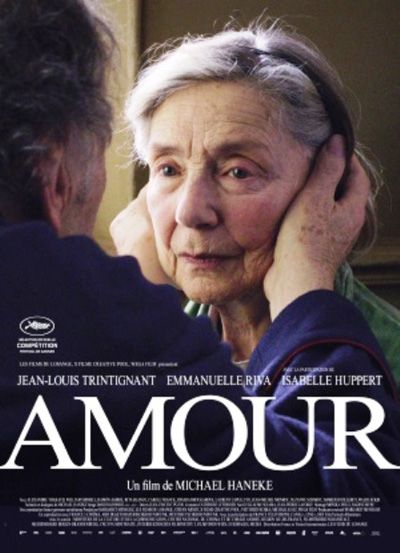
Amour (Michael Haneke) [118 points / 10 votes]

"“Imagination and reality have little in common.”

The above quote, in a nutshell, can summarize not only the the central theme of Amour, but also the oeuvre of its creator, director Michael Haneke. Over the course of his career, Haneke has acquired a bit of a bum rap. Most criticism surrounding his work involves some negative connotation of the word “provocateur,” but the fact of the matter is that Haneke respects his audience far more than they often respect themselves. Haneke is, above all, an existential observationalist -- a man obsessed with taking a long and hard look at the world we live in, seeking through cinema an answer to the questions that whisper from the darker corners of the conscious mind. Who are we, really? What, exactly, is the nature of our existence? As a director, Haneke’s technique for finding the answers to these questions is grounded in a willingness to peer into the abyss and initiate a defiant dialog with whatever demons raise their hoary heads. As his career has progressed, his talents as a filmmaker have become more pointedly focused, presenting scenarios that challenge our humanity directly by showing individual aspects of life as it truly is, rather than as we imagine it to be.

In Amour, Haneke fixes his gaze, and ours, on the greatest of all existential crises -- the looming inevitability of death -- and achieves something close to the perfection of his art. At its heart, Amour seems a simple story -- the struggle of a husband and wife against humanity’s most invincible opponent. But, as the quote above reminds us, the reality of what we are about to experience is very different from what our imaginations might lead us to assume. Nothing in a Haneke film exists merely as surface; everything, as it is in life itself, is layered with deeper meaning and significance. As the story unfolds, these meanings emerge from the scenery and, more importantly, from the extraordinary performances of veteran actors Jean-Louis Trintignant and Emmanuelle Riva, to reveal a story not only about the tolls taken by the ravages of time, but a miraculously clear-eyed vision of the sublime power and purity of marital love. It is a vision all too rarely conveyed within the world of film, and it packs a power that saturates the soul, leaving a haunting appreciation that lingers and deepens in the mind as our own time marches inexorably forward.

And therein lies a minor miracle; an epiphany, if you will. Haneke has shown that, while imagination and reality may have little in common, it is the imagination that sows the seeds of the real. It is a deeply humanist perspective, and one that is based on a love of mankind as deep and abiding and unselfish as the love shared between Georges and Anne. With Amour, Michael Haneke has proven once and for all that the only provocation he is guilty of is teaching us look a little harder at who we are in order to become the souls we wish to be." - Donald Carder

2012 Film of the Year Countdown: #12


Cosmopolis (David Cronenberg) [107.5 points / 10 votes]

"In the year of “Big Data” and Nate Silver, the film that speaks most strongly to today’s world is one that exists in a completely artificial one -- David Cronenberg’s Cosmopolis, a work as radical as anything he’s made since Videodrome, and in many ways that film’s inverse. A rip-roaring comedy about the psychology of data and capitalism, Cosmopolis takes us through the journey of a billionaire whose belief in digital patterns is questioned when he is unable to comprehend a disastrous fall in the yuan. In Cronenberg’s world, digital life is a cracking façade: monotone dialogue pops like a screwball comedy, the limousine slowly deteriorates into a piece of junk, and our protagonist’s body physically corrodes in the most absurd of ways.

Cronenberg’s control of each facet of his film is pristinely precise. The performances by its marvelous cast work through the extremely complicated dialogue without ever once flinching (most notably the bravura performances by Robert Pattison and Sarah Gadon). And Cronenberg emphasizes the artificial in every frame while slowly allowing glimpses of creeping humanity like little pinpricks. Edited and shot with razor-sharp skill, Cronenberg’s adaptation of Don DeLillo’s novel might seem like the film the Occupy Wall Street movement has been waiting for, but it’s more of an attack on our constant investment in the signs, symbols and patterns of digital life today. Two characters realize they both have asymmetrical prostates, and one demands to know its meaning; the response: “Nothing... a harmless variation.” The most unsettling thing in Cronenberg’s vision of the future is realizing that not everything can fit neatly into models." - Peter Labuza

2012 Film of the Year Countdown: #13


The Kid with a Bike (Jean-Pierre and Luc Dardenne) [90 points / 9 votes]

"The Kid with a Bike is possibly the closest the Dardennes have come, to date, to making a “traditional” movie. Known for a pared down, ultra-realist approach to filmmaking, their body of work has traditionally abstained from many commonplace devices such camera set-ups, tight scripting, use of music, and (the biggest of the bunch) endings. Dardenne films tend to end abruptly, in media res, the message being that while the camera may be off, the characters and the story will continue on. Much like life, beginnings and endings are never black and white.

Bike tells the story of Cyril (the brilliant Thomas Doret, my pick for Best Actor), a young boy who has been abandoned by his father. Cyril clings to his bicycle, most likely a gift from the Father and the only thing in the child's life to show for the relationship he so deeply yearns for. The drama that unfolds takes on a deeper, almost melodramatic tone as the Dardennes introduce what is only their second use of music in a film to date. Using only a few brief chords from Beethoven's "Adagio," the filmmaker's heighten their craft and transcend what has become their signature style. What follows will perhaps go down as one of the most heartbreaking yet inspiring films of this decade: as Cyril struggles to make a connection in the world, the film literally reaches out to us at moments and sings. The results are simply magnificent. The Dardennes do not betray the reality they are so careful to create; they are merely brave enough this time around to give it a weapon. Fuck 3-D. Give me Beethoven." - Adam Lemke

2012 Film of the Year Countdown: #14


The Loneliest Planet (Julia Loktev) [87 points / 8 votes]

"There wasn’t a runaway first-place epic in 2012 along the lines of my choices in previous years. Instead, there was a glut of extremely interesting, deceptively simple “little” films. For me, the Best Film of 2012 was a four-way tie between The Loneliest Planet, The Kid with a Bike, Oslo August 31st and Goodbye First Love. All are quiet, expert dissections of relationships.

Asked to arbitrarily pick one from the group, I went with The Loneliest Planet, Julia Loktev’s relational pre-mortem. Planet is the “simplest” of the aforementioned bunch, relying on only three characters doing essentially one thing – hiking -- through the whole movie. The film’s source material -- Tom Bissell’s short story “Expensive Trips Nowhere” – is an acknowledged riff on Hemingway’s “The Short Happy Life of Francis MacComber": man, woman, and guide hike through Eurasian hinterlands; man fails woman during key moment, woman cuckolds man with guide.

Leaving aside the savage brilliance of Inti Briones’ cinematography and the flawless performances by the three leads, Loktev’s film is remarkable as an example of transcendent adaptation. I mean no slight against Bissell’s story, but Loktev takes the skeleton of the story and infuses it with mystery and, most importantly, SPACE. Her approach to the material reminds me of Carl Th. Dreyer’s approach to set design: keep stripping everything away until only the essentials remain (and, even then, jettison as many “essentials” as you can). What remains is a beautiful look at a relationship unraveling before it’s even properly raveled. Loktev has taken the source material’s jaded married couple and turned them into a recently engaged pair with their wedding awaiting them once they return to the States. Again, this is a deceptively small tweak but one that turns a potentially cynical take on relationships into a protective (but still hopeful) view.

The film exalts in space -- both geographic and psycho-spiritual. There’s a lot of quiet and a lot of time watching the characters wander quietly through the Caucasus. This emptiness isn’t for everyone. In Roger Ebert’s ** ½ star review, he cites this as a detriment:

“All of this grows tiresome. We're given no particular reason at the outset of "The Loneliest Planet" to care about these people, our interest doesn't grow along the way, the landscape grows repetitive, the director's approach is aggressively minimalist...”

Eh. One man’s aggressive minimalism is another’s cherished subtlety. And the characters are drawn with enough subtlety that each works at one time or another as an audience surrogate. As to the charge of not caring: I feel like the film’s brief, pre-hike prologue imbues the couple with enough Everyperson stakes that, if you’ve ever been in an unstable relationship, there’s enough to care about. (I also hate the “we don’t care about these people” argument as a rule; does Bernal have to announce that he plans on saving a bunch of orphan puppies at the end of the trip to make us root for him? Isn’t shared humanity enough to make us invest?)

Finally, the brilliance of Planet lies in its fulcrum scene, which takes Godard’s adage about only needing a girl and a gun to make a film in a fascinating, exhilarating direction. Maybe it’s because it’s surrounded by so much space, but it’s a master stroke of dramatic tension and one of the best directed scenes of the year. I won’t spoil it, but it alone is worth the hike." - Philip Tatler IV

2012 Film of the Year Countdown: #16 (tie)


Tabu (Miguel Gomes) [77 points / 7 votes]

"It's been five years since we last heard from Hou Hsiao-hsien (aside from repeated assurance that a martial arts epic is on the way) and nearly as many for Tsai Ming-liang, whose great 2009 Cannes competition entry Face, a forever-ago three years in the rearview now, proved too challenging for most, evaporating altogether shortly after its festival run. This makes it look as if the grip these Taiwanese titans once had on the whole of world cinema could be loosening, and that's left a big open space for another country to claim. While both Argentina and the 'Berlin School' directors have submitted worthy resumes, it's Portugal that's proved the most compelling applicant. The country can call birthrights on the world's oldest (and arguably greatest—living) filmmaker, Manoel de Oliveira, along with a host of outlier talents (notably Pedro Costa and João Pedro Rodriguez) who've enjoyed enthusiastic acclaim in certain circles. What Portugal's lacked, however, is a kind of crossover talent, a director who can at least appeal to a broader arthouse audience, if not a mainstream one.

Portuguese former film critic and theorist Miguel Gomes never seemed like the man for this job; his first two features constituted a quasi-musical (The Face You Deserve) and a two-hour-plus freeform docudrama (Our Beloved Month of August), both considered 'deep cut' arthouse items. But the director's latest, Tabu, is a departure: It's one of the most accessible of the Great Portuguese Films. Shot entirely in black-and-white, on 35mm and Super 16 in the weirdly-popular-of-late academy ratio, and with more than half of its runtime devoid of dialogue -- a silent film but for an exquisite narration and selective foley sounds -- it wouldn't seem to be a popular favorite on its face. But then there had to be something good to come out of the existence of The Artist, and this film's relative, growing popularity seems to be it. Gomes's understanding of cinema, including his interpolation of silent film specifically, is more sophisticated than Michel Hazanavicius's generalized and annoyingly hammy tribute to the silent era. It's also, at least in one its many readings, a deeply felt romantic reverie: Gomes disguises, both sincerely and ironically, a complex evocation of national identity within the traditional bifurcated narrative of an old, white woman exoticizing her past.

Gomes draws specifically from F.W. Murnau by splitting Tabu into two sections: "Paradise Lost," then "Paradise" -- a reversal of the titles that divide Murnau's Tabu: A Story of the South Seas. (Gomes's film also pulls a lot of other elements from Murnau's, including a naturalism that tends to lead this fiction into documentary territory.) Preceding these two distinct passages is another self-contained narrative, a prologue about a melancholy European explorer who treks through the wilds of Africa, mourns his deceased lover, is taunted by visions of an ominous crocodile, and finally commits his body to the bottom of a swamp. Natives look on with expressions of bemusement and indifference... and then a reverse shot reveals that these have all been the events of a film-within-a-film. Pilar (Teresa Madruga), a solitary, middle-aged woman, is illuminated by the light of a movie theater screen, patron to a cinema in modern-day Lisbon. "Paradise Lost" begins in earnest.

Pilar soon receives a request to go and fetch her eccentric elderly neighbor, Aurora (Laura Soveral), who's stricken with dementia and prone to ruinous gambling and making up paranoid stories about her long-suffering African housekeeper, Santa (Isabel Muñoz Cardoso, the memorably murderous face that greets us in Pedro Costa's Colossal Youth). When Pilar locates her very broke neighbor, one of Tabu's two central monologues occurs: Aurora's batty account of a surrealistic dream she had, one loaded with racial shadings (the word "monkey" is repeated to an uncomfortable degree). Thereafter, Gomes devotes this first section to exploring the effects of a uniquely Portuguese condition: These characters seem to be experiencing the pangs of saudade, a sensation central to Portuguese culture (especially its art) and with no literal English translation. Loosely, the word refers to a kind of longing, but often for something that never was or could even really be defined, symptomatic of a deeply unmoored society that has suffered from something of an identity crisis since before even the Carnation Revolution. Gomes sensitively engages with these characters' melancholia, but he also gently suggests that their isolationism is their own doing. Eventually, a mysterious man from Aurora's past enters the movie and the rest of Tabu is given over to a visualization of his remembrance-cum-monologue.

The next section, "Paradise," transports us back 50 years, stylizing the events of Aurora's torrid youth spent in an unnamed African country (echoes of Claire Denis's White Material) at the base of the (fictional) Mt. Tabu as a silent movie vis-à-vis the cinephiliac Pilar's imagination. However, Gomes's intelligence again permeates and penetrates this romanticized ideal; while the young Aurora (Ana Moreia), her lover Ventura (Carloto Cotta) and the other European characters around them are all prone to expressions straight out of silent-era melodrama, the African natives and their environments are, again, depicted with a naturalism verging on docu-realism. This conscious choice registers as a sly critique of romanticized notions of colonialism and of general cultural whitewashing in cinema, but one subtle enough not to disenfranchise us from the heartfelt nature of the film's forbidden love affair.

Gomes walks a fine line, interrogating the surface pleasures of this romance with various intellectual subtexts, but the balance he strikes is pitch perfect. As frequently as he gestures toward criticism, he also invests himself in his protagonists' happiness. Aurora and Ventura, for instance, are allowed a rapturous moment of coitus; even more swooningly, most of Tabu's principals eventually come in contact with a Portuguese cover of the Ronettes' "Be My Baby." The song first appears in a film Pilar's watching and later surfaces in the "Paradise" section, strengthening the sense that what we're seeing is a kind of film of Pilar's imagining. Ventura hammers out a drum track to it when his band is off recording in a studio, far away from his beloved Aurora, tearing up throughout. Gomes does like to goof, tweaking believability and authenticity (the best joke comes when Ventura's band mimes along to another Ronettes track, "Baby, I Love You," except it's the Ramones' cover) and filtering things through Pilar's perception (hence lots of appearances of that ominous crocodile from the prologue). But he makes sure to note near the end that the peculiar outcome of Aurora and Ventura's story "sparked an uprising" in Africa.

Another joke, that -- obviously. But this particular one resonates deeply with the reflexivity that is this film's masterstroke: There are many ironies to be found throughout Tabu, but they're never condescending. Instead, they make Gomes's takes on everything from European colonialism to cinephilia to the pure pleasures of cinematic storytelling that much more rewarding, rich, and true." - Sam C. Mac

2012 Film of the Year Countdown: #16 (tie)


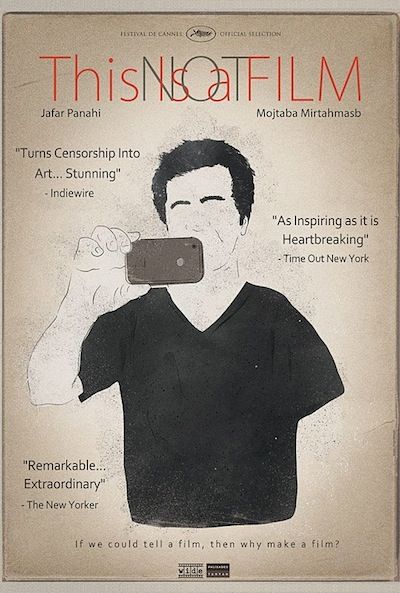
This Is Not a Film (Jafar Panahi & Mojtaba Mirtahmasb) [77 points / 7 votes]

"Jafar Panahi’s “not film,” recorded from the confines of his apartment building during his widely publicized house-arrest, then courageously smuggled out of Iran on a thumb-drive hidden inside of a cake, is a simultaneously maddening and liberating viewing experience. Maddening for the obvious reasons: one of the world’s great auteurs has been banned from writing and directing for decades at the mandate of an unjust, totalitarian Iranian government. A sequence in which Panhi acts out scenes from a movie he aspired to make before the ban, standing within a crudely taped blueprint of the set on his living room floor, is painstaking. But it’s liberating to know that, even when oppressed by the tyrannical legal system of his homeland, Panahi cannot be kept from his art. This is Not a Film is as vital as anything Panahi has ever made, with a closing shot for the ages." - Danny Baldwin

2012 Film of the Year Countdown: #18


Life of Pi (Ang Lee) [74 points / 7 votes]

"Nobody has ever accused Ang Lee of not being a thoughtful, intelligent, hard-working director. But a lot of people have voiced concerns that his hard work sits on the screen a little nakedly, that he’s a honest, literal-minded plodder who’s been known to drain all the magic out of such subjects as Marvel Comics superheroes and the nostalgic glow of Woodstock Nation. So in a year marked by some very unlikely triumphs, Lee’s Life of Pi may be the unlikeliest of all. Lee’s adaptation of Yann Martel’s fantastical novel catches the spirit of the material, but Lee’s careful, measured approach also grounds a project that could easily have wafted away or congealed into inspirational whimsy. The movie looks as if Lee had concentrated all his focus on turning every frame into something you can never forget, an accomplishment he pulls off without lapsing into empty “style.” The result is a thrilling, epic adventure that’s largely set on a lifeboat, with a stirring cast of two, only one of whom actually exists and is available for interviews. It’s 127 minutes of sheer wonderment, with wonders that include Gerard Depardieu’s best and fullest performance in many years, which basically consists of a single glower." - Phil Dyess-Nugent

2012 Film of the Year Countdown: #20


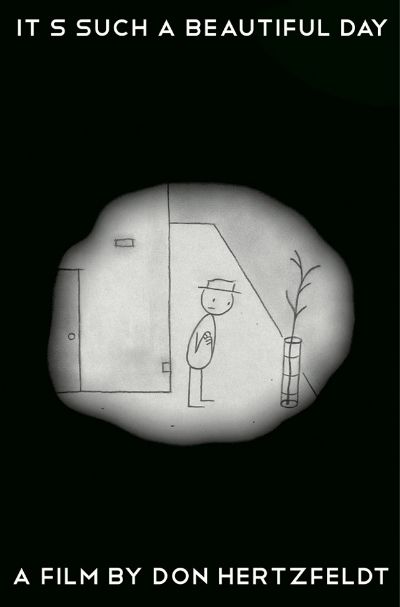
It's Such a Beautiful Day (Don Hertzfeldt) [71 points / 7 votes]

"It's hard to know where to begin when discussing Don Hertzfeldt's first feature, It’s Such a Beautiful Day. The temptation is to start with its production, whereby Hertzfeldt more or less made the whole thing himself, serving as director, writer, producer, animator, narrator, cinematographer, sound recordist and mixer, music supervisor, and even distributor. Then there's the long journey the film has taken to reach its finished form -- originally intended as a trilogy of short films, Hertzfeldt finished the first third of the movie in 2006 and the second in 2008, and only decided to combine them into a feature this past year after completing the third installment.

But then I keep coming back to something written by online critic and fellow Muriels voter Peter Labuza: "this film made me feel ALL THE FEELINGS." Honestly, I don't think I can put it better than that, though that won't stop a damn fool like me from trying.

I still remember vividly my first experience watching It’s Such a Beautiful Day in its earliest incarnation, back when it was called Everything Will Be OK. While Hertzfeldt's trademark stick-figure animation style was familiar to me from his earlier works, the tone felt altogether different. In telling the story of Bill -- an everyman hero perfectly suited to his minimalist design -- Hertzfeldt largely downplayed the absurdist comedy of Billy’s Balloon and Rejected in favor of close observation and anecdotal, almost Carver-esque storytelling. True, the final scene of Rejected and most of The Meaning of Life hinted at this more serious direction, but the depths he was plumbing with this latest work were unexpected, not to mention invigorating. As I told someone just after I saw it, "I'm almost scared to see what he'll do next."

Eventually, with the releases of chapter 2 (I Am So Proud of You!) and chapter 3, it became apparent that there was more to Bill's story, and that Hertzfeldt wouldn't go about telling it in a conventional manner. Rather than picking up where the first chapter leaves off, I Am So Proud of You! delves into Bill's past- or at least a fever-dream version of it fueled to some extent by the mental damage we first saw in chapter 1. Bill recalls his family history as one of physical and psychological hardship, disability and insanity, and an unfortunate tendency to be hit by trains.

Of the three sections of It’s Such a Beautiful Day, chapter 2 is the one that's most prone to Hertzfeldt's brand of gallows humor, which has become a sticking point for some critics. However, it also contains it share of poetic moments, including a long static shot of a man using a leaf blower that Hertzfeldt contrasts to the reality of Bill's life, which is nearing its end. I Am So Proud of You! finds Bill coming to terms with death -- both the one that awaits him and the deaths of those who've come before.

If chapter 2 deals with Bill's past, so the final chapter is about his future, as he (and we) contemplate what exactly that means. Having followed Bill this far, Hertzfeldt feels conflicted about where he should end his story, and this conflict is at the center of the final chapter of It’s Such a Beautiful Day. On the one hand, a story like Bill’s practically demands closure; on the other, when that closure involves killing off your hero, it can be hard to pull the (metaphorical) trigger. The way Hertzfeldt resolves the conflict is brilliant- --if you haven't seen the film, I won't spoil it for you here, except to say that It’s Such a Beautiful Day contains the best use of the long-tail ending since Spike Lee’s 25th Hour a decade ago, and one that's every bit as emotionally draining.

In the end, what sticks with me is the breadth of emotions -- ALL THE FEELINGS, in the words of Mr. Labuza -- summoned up by Hertzfeldt's masterpiece. It’s Such a Beautiful Day runs the gamut: sick-humor gags like Bill's retch-inducting supermarket observations, images of simple beauty such as a single flower sprouting from a poor man's shallow grave, bits of horrifying cinema like the much-ballyhooed "the pipe is leaking" sequence, deeply sad scenes like Bill's flash-forward (or is it just another hallucination?) to his last words. And while some would search for influences for Hertzfeldt's work -- It’s Such a Beautiful Day’s juxtaposition of the personal and the cosmic calls to mind Terrence Malick, for one -- it's also clear that Hertzfeldt, forever plugging away at his animating table (he once told the A.V. Club, “I feel stupid when I’m not in production on something”), is in a league of his own. Once again, I'm almost scared of what he'll do next. And I can't wait to find out what exactly that will be." - Paul Clark

2012 Film of the Year Countdown: #21


The Cabin in the Woods [66 points / 8 votes]

"Five college students off to spend a weekend up by the lake -- it's an archetype that immediately strikes fear into the heart of the potential viewer. The template has been applied to horror films, reality TV, or -- most insidiously -- mid-'90s 'indies' where twentysomethings talk about their feelings. Thankfully, The Cabin in the Woods decides to go with true horror.

The film's portrayal of its target audience is interesting, both flattering and sympathetic while at the same time solipsistic and selfish (youth is often portrayed in this fashion in horror cinema, both to insulate its proceedings from the outside world and to in some way justify the slaughter that comes down against them). It's almost inadvertent the way the film completely tears apart the mechanism of reality TV -- watch how the five are molded, through chemicals and manipulation, into becoming their chosen archetypes. What is demanded is no innovation, and the same scenario served up again and again.

It's fascinating that a film so concerned with archetypes and formulae instead feels liberating. When the System Purge is activated and hundreds of cubes of nightmare fodder are unleashed into a common space, it provokes a general awe (think back to playground-based 'If X fought Y' theory), but also a leveling of the playing field where giant critters, the legacy of violence and sexual abuse, stabby unicorns, and angry molesting trees all have equal footing to get into the subconscious.

The Cabin in the Woods is a remarkable achievement about the acts of making and watching a film. Its great moments (and there are several) all deal with a sudden shift outward in perspective, where a limited view just doesn't get across the scope of what's actually happening onscreen. And then in its final third, all bets are off as the parameters expand; everything goes crazy and things get cosmically awesome (a correct word in both fanboyish and divine connotations)." - Jason Shawhan

2012 Film of the Year Countdown: #23


Beasts of the Southern Wild (Benh Zeitlin) [51 points / 5 votes]

"Beasts of the Southern Wild was the film I saw in the theater more than any other in 2012. I went back again and again because, for me, it was last year's greatest example of that thing that hooked us all so long ago - movie magic. Benh Zeitlin's bayou fairy tale positions us, rightfully, as just one more animal and the lessons it imparts are those things that help us survive and be the (occasionally) noblest and smartest in the kingdom: Self-reliance is key, no one is going to do it for you. Be brave. Be strong, but not at the expense of those weaker than you. We all live and love and struggle, if we're lucky, so don't ever quit.

Much has been made of Quvenzhane Wallis' central turn as Hushpuppy, and with good reason. She has a charisma that you don't see in folks all that often. I wouldn't exactly call it a performance in the traditional sense - I think it's her instincts equally combined with the direction and editing that form an outstanding whole - but I don't typically give a good goddamn about the traditional sense. I have never seen such a perfect depiction of the interior world of a six year-old kid and how they think the world keeps on spinning on the screen before. When you're six, it is magic. To show it as any less would be untrue, and every bit of that magic is in this girl's face. Every smile, every tear, every howl, every look of surprise or understanding is appropriate and affecting and made me wish I knew this character better. That's no small feat, no matter how small the actress.

I have read the criticisms of this film, some perfectly legitimate, some completely ridiculous, and I have to say none of that means a lot to me. The ramshackle brilliance of the thing is a triumph of resilience and imagination. It's not perfect, but you know what? Neither am I. It belongs to the lineage of great American stories and storytellers, cinematic and otherwise, that I love precisely for their imperfections. It makes me want to celebrate and ponder. It makes me long for summertime. It makes me want to get in a fight and break bottles. It makes me want to grab this life and shake every last bit from every experience, even dying. Yes, it has flaws, but it's as good as any of us on our best day and that's often better than we deserve. The wild joy it displays inspires me, the stiff backbone it advocates galvanizes me and the fact that there is still an old, weird America reassures me. That, my friends, is why I go to the movies. Hushpuppy is my hero." - Cole Roulain

2012 Film of the Year Countdown: #25


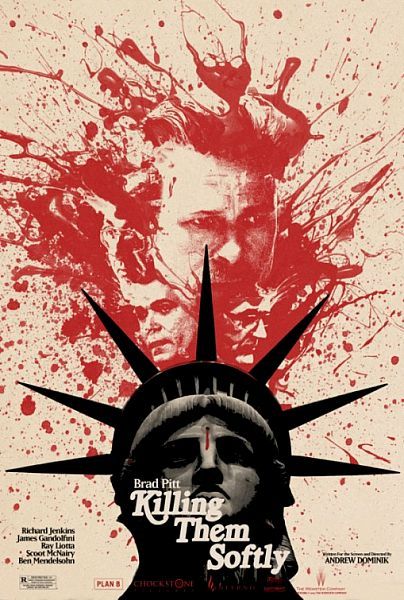
Killing Them Softly (Andrew Dominik) [45 points / 4 votes]

"In a better world, there would be at least a half-dozen ‘70s movies based on the works of George V. Higgins, but in this world, there’s only one: The Friends of Eddie Coyle. Of course, even if there were a half-dozen more Higgins movies, it’s hard to imagine any of them doing it better than the 1974 Peter Yates film starring Robert Mitchum and Peter Boyle. Higgins’ down-on-their-luck tough guys, low-rent crimes, grungy Boston locations, and most of all, his hard-bitten, often hilarious, sometimes impenetrable thickets of dialogue all made it to the screen intact. But the movie disappeared for decades before Criterion finally gave it a new life on home video in 2009, and no more Higgins adaptations would follow until Andrew Dominik’s Killing Them Softly (based on the 1974 novel Cogan’s Trade) reached theaters last November.

Dominik’s film didn’t meet with any warmer a reception from audiences than Yates’ had, but it’s a worthy follow-up in every way. It’s the best sort of adaptation, in that it fuses an extremely faithful reading of Higgins’ book with a genuinely exciting cinematic vision. In its dialogue scenes played out in taverns and cars and hotel rooms, it feels like a ‘70s movie, but its action sequences are rendered in a contemporary, muscular filmmaking style undreamed of in 1974. Dominik’s script keeps much of Higgins’ distinctive dialogue intact, but it also introduces what is not so much a subtext as an overlay that ties the movie’s self-contained world to more universal themes.

Dominik sets Killing Them Softly in 2008 on the eve of the presidential election; then, as now, the economy is much on everyone’s mind. He shot the film in New Orleans but retains all of the geographical references to Boston and its surroundings from the Higgins novel. As a result, the movie is set not so much in a real place as a mental landscape with a pervasive air of end-times-of-America rot. In this not-quite-reality, lowlife hoodlums listen to NPR on their car radios, and even the seediest bars have C-SPAN playing on the televisions. The talking heads and politicians we overhear act as a sort of Greek chorus, commenting on the movie’s action. (Example: after a couple of small-timers knock over a poker game and throw the entire criminal underworld into chaos, we hear George W. Bush proclaiming that we must not allow the irresponsible actions of a few to take down our entire system.) Some viewers found this device intrusive, but I see it as a rather Altmanesque touch; it’s there if you want to pay attention, but easy enough to ignore.

The economy under scrutiny in Killing Them Softly is that of a closed society: white criminal males. The only woman who gets any screentime at all is credited only as “Hooker” -- in this world, she’s just another transaction. That’s how Jackie Cogan (Brad Pitt) sees his work as an enforcer; the title comes not from the Roberta Flack song but from Cogan’s approach to killing for hire. He likes to do it from a distance, make it as impersonal as possible, just like the big banks. Pitt delivers a wry turn as this most practical of gangsters; he makes every matter of life and death sound like a reasonable negotiation.

Like our own capitalistic system, the underworld in Killing Them Softly has a corporate structure. We never see those at the top and they never get their hands dirty. Middle-management is represented by Richard Jenkins, who acts as Cogan’s go-between (he might as well be a corporate accountant). Then there’s the 99%, which Dominik populates with a terrific collection of character actors, some of whom echo gangster pop culture’s past (James Gandolfini, Vincent Curatola and Max Casella from The Sopranos, Ray Liotta from Goodfellas, rapper Slaine from Ben Affleck’s Boston crime pictures), some of whom make their mark here for the first time (most notably the terrific Scoot McNairy as nervous stick-up man Frankie).

Unlike many of this year’s bloated Oscar contenders, Killing Them Softly weighs in at a lean 97 minutes and yet still finds the time for Higgins’ gift of gab. That’s particularly true in Gandolfini’s scenes as Mickey, a hired gun who proves to be a rare bad bet on Cogan’s part. After so many years as Tony Soprano, it’s hard to believe Gandolfini could turn in another distinctive mobster turn, but he pulls it off here. Mickey is a melancholy figure, past his prime and living in his memories of better days; brought into town to pull off a hit, he does nothing but drink, cheat hookers out of their tips, and regale a bemused Cogan with his life story.

The lyrical interludes are punctuated by bursts of gut-bucket violence. Some of it, as in the hit on Liotta’s character, is so beautifully abstracted as to be Lynchian (a connection made explicit in that scene through the use of Ketty Lester’s “Love Letters” on the soundtrack). At other times, it’s simply brutal and matter-of-fact. Either way, the result is the same, as the shots of naked bodies being loaded into drawers in a morgue make plain. “In America, you’re on your own,” the cynical Cogan sneers while the TV plays Barack Obama’s acceptance speech. But Dominik knows what Higgins knew: When the end comes, we’re all in it together." - Scott Von Doviak

2012 Film of the Year Countdown: #33 (tie)


Rust and Bone (Jacquies Audiard) [29 points / 3 votes]

"Morality in a Jacques Audiard film is relative. He builds his stories on the assumption that the world is dangerous, violent and corrupt, then he lets the action play out from there. He is interested in extreme circumstances and the people you find there. His characters are highly functional outsiders -- living, breathing contradictions at odds with themselves and the world around them who often hold secret aspirations they’ll do anything to protect. He finds beauty in unlikely places and twists undeniably attractive people, real life movie stars, into dark poses that makes them almost unrecognizable. Marion Cotillard is one of the most beautiful women in the world, but it’s hard to imagine her looking less glamorous than she does in Rust and Bone.

The script was loosely adapted from a book of short stories by Craig Davidson with Audiard’s long-time collaborator Thomas Bidegain but it’s obvious that only a director with a finely tuned sense of cinema, not to mention some serious balls, could push this material where it needed to go. It’s brutal territory both mentally and physically, for the characters and the actors who play them. In fact, without the flesh and blood that Marion Cotillard and Matthias Schoenarts sacrifice to these roles (at times literally) I can envision Rust and Bone being an outright failure. Fortunately they bring honesty and depth to an orca trainer and street fighter respectively, giving life to two characters it’s fair to say we’ve never seen in quite the same way on a movie screen. The terms of their relationship are laid out when Stephanie, treating her untamed lover like the whales she used to train, tells him that they must proceed with ‘delicacy’ - ‘not like animals.’ They seem like an unlikely couple from their first meeting which makes their developing romance more interesting and the redemption they find in each other ultimately more rewarding because the conclusion they arrive at doesn’t come easy. Audiard should also be credited for using CGI as a necessity to serve a very real story (not a single super hero or spaceship in sight).

Audiard has been called the French Scorsese, an easy headline that has some truth to it. Audiard’s films have a confident chaos that calls to mind Scorsese’s better work, carefully scripted but always given room to move. Both are interested in the complexity of human nature, taking characters from the street and making them universal. Both depend on big moments and music cues that don’t require Shazam. Neither shies away from the realities of violence and their visceral style of filmmaking is never afraid to make an audience uncomfortable, if only to make the eventual payoff that much sweeter. In a different director’s hands (Clint Eastwood, for example), this same script could have ended up being about overcoming disability or life lessons learned from boxing or, worst of all, heart-tugging Oscar bait. (I hope Audiard fights any attempt at an English-language remake tooth and nail.) Watching Audiard's films can feel like chewing aspirin without water to wash it down: it’s bitter medicine, but once you’ve developed a taste for his work there are few directors who can offer an audience the same kind of hard-fought reward. It’s a shame American audiences are so averse to subtitles because simply by switching Rust and Bone from French to English, it would have doubled the attention it got without a single compromise." - Bryan Whitefield

2012 Film of the Year Countdown: #43


A Simple Life (Ann Hui) [23.5 points / 3 votes]

(Initially published here; reposted here with the author's permission.)

"On its surface, Ann Hui's A Simple Life plays like an Ozu-ish family drama, carefully observed and in touch with a basic shared humanity with the audience that isn't overcooked by the trappings of plot or melodrama. This, it accomplishes very, very well, and it's no wonder that the film has become the director's biggest hit and an award winner wherever it plays. It's one of the year's most pleasurable dramas. If I see a gentler, more humane film this year, I'll be shocked. If it only worked on that level, it would be amazing enough, but it plays a deeper game, too.

The story here follows the relationship between film producer Roger and his family's longtime nanny/caretaker, Ah Tao. Ah Tao came to Roger's family shortly after World War II, and has served them ever since. She's very much a family member rather than hired help and Roger relies on her for everything: food, housekeeping, style consultant, you name it. While Roger is in Beijing closing a deal for his new film, Ah Tao suffers a stroke. One her hospital bed, she tells him that she is retiring and that she wants to go to a home for the elderly. Roger finds a home run by one of his former stuntmen and soon Ah Tao is living there. She's the liveliest of the home's residents, and Roger's devotion to her is the envy of her fellow retirees. Meanwhile, Roger must do for himself, and he doesn't do such a good job of it. You never know what you have until it's gone, it seems.

A Simple Life is a character-driven film rather than a plot-driven film, and its frequent moments of wry comedy are derived from a close observation of how its characters live. Ah Tao's delight in returning home for a visit, for instance, is punctured with a couple of funny moments when she realizes that Roger isn't dusting the house to her standards. In another scene, near the end of the film, a troupe of entertainers comes off stage after entertaining the folks living in the retirement home and the peppy facade drops to one of "it's the end of my shift, can't this ever end." It's a fleeting shot, wordless, but it speaks volumes of the characters involved and of changing attitudes toward aging in a youth-driven culture. Other fun comedy bits: Uncle Kim, one of the other residents, whose frequent begging for money is finally shown to be supporting a predilection for prostitutes, at which Ah Tao just shrugs; Roger's frequent run-ins with people who take him for a bike messenger/taxi driver once he's forced to pick his own clothes; the voyeuristic way the other residents watch Roger's visits. This is all fun to watch.

This isn't a comedy, per se, though, and there's a persistent ambient melancholy. The rest home isn't necessarily populated with movie characters so much as it's a warehouse of final extreme, more hospice than community. The shadow of Ah Tao's mortality, of the film's only logical conclusion, tinges the film's warm humor with a touch of the gallows. This seeps into the performances. Deannie Yip's Ah Tao is an unsentimental woman, warm but stern, and she's very much aware of her how her life is progressing. I like that she faces it without a lot of fuss. Roger is played by Yip's real-life godson, Andy Lau, who normally plays more glamourous roles. He's kind of a doofus in this film, but he matches Deannie Yip's natural warmth. Watching the two interact like old, old friends is the heart of the movie, and the pair has a natural chemistry. This has terrific performances.

The melancholy I felt while I was watching A Simple Life is a bit broader than I can easily chalk up to the relationship drama, though. There's a meta-cinematic dimension to this. Director Ann Hui apparently intended the film as her last before retiring herself, and there's a level of personal involvement evident in the ways she has chosen to accessorize the film. Hui, I should mention, is one of the major directors to come out of the Hong Kong New Wave. Her early films, either as a crew member for Tsui Hark or as a director unto herself, are part of the explosion of color and action that defined Hong Kong film for a decade and a half in the 1980s and 90s. Hui was among the first to break away from the action film ghetto, though, and she's been making contemporary dramas for three decades now. In spite of that, she's still intimately connected with the history of Hong Kong film, and at least a part of A Simple Life seems like it's an elegy for a Hong Kong cinema that no longer exists. The fact that Roger is a film producer allows Hui to indulge in a deeply meta-cinematic summation of her own career. She connects herself to that career by casting numerous figures from the HK New Wave in small parts, whether it's Raymond Chow, Sammo Hung, and Tsui Hark as the filmmakers at Roger's Beijing meeting or Stanley Kwan at the premiere of Roger's new film. The stuntman who owns the retirement home is the ubiquitous Anthony Wong (late of Johnnie To's repertory company). There's a bitterness in Roger's assessment of his film--he thinks it's not any good, and there's a hint that he's trapped in the HK Action idiom of the 1980s, endlessly making new versions of The Three Kingdoms. The film's best line is Roger's, when he says, "I'm glad I'm not a big star." Of course, Andy Lau is a gigantic star, so the irony cuts deep.

My cinematic education came of age while the Hong Kong New Wave was unfolding. I have a deep well of affection--affection, hell; abject love--for those films and filmmakers. That explosion of creativity was the best fireworks show in cinema in its time and it's not lost on me that one of the signature images in A Simple Life is a vast fireworks display. Watching A Simple Life is bittersweet for reasons well beyond the drama itself because I get the feeling that it's an elegy for that cinematic idiom. I mean, yeah, there are still filmmakers who work in that idiom, but the great filmmakers have either moved past it (To, Wong Kar Wai, Ann Hui herself) or become creatively stagnant within it. What we are left with from that time are cometary remnants falling to earth and guttering out. This film mourns for the fireworks, I think." - Christianne Benedict

2012 Film of the Year Countdown: #52


Sound of My Voice (Zal Batmanglij) [20 points / 2 votes]

"To call Sound of My Voice a science fiction movie would do a disservice to its intense personal drama, and to call it a character-driven drama would do a disservice to its fascinating sci-fi mysteries. With an infinitesimal budget compared to studio sci-fi movies, Sound of My Voice crafts a more engrossing and unsettling vision of the future than any other film of 2012. It does so primarily through the masterful performance of co-writer/co-producer Brit Marling as Maggie, who claims to come from the year 2054 and has amassed an alarmingly dedicated group of followers. Solely through the way she describes Maggie’s harrowing native era, Marling conjures up images of humanity’s end and is completely believable as a charismatic leader who could garner a fervent following.

Marling’s haunting intensity is offset by Christopher Denham and Nicole Vicius as Peter and Lorna, the documentarians who try to infiltrate Maggie’s cult, and Marling and director/co-writer Zal Batmanglij expertly balance the couple’s skepticism with the enticing and terrifying possibility that Maggie is telling the truth. The scene in which Maggie talks Peter through an absurd-seeming vomit ritual in order to prove his loyalty is one of the most indelible movie moments of 2012. It’s both hypnotic and disturbing, just like the rest of the movie, which sticks to its eerie ambiguity all the way to the end." - Josh Bell

2012 Muriels: A moment of healthy dissent

While we're all about celebrating the positive here, I'm also not naive enough to assume that everyone is in agreement about everyone else's choices or perception of the year past. In that spirit, here's a quick piece, hopefully meant to stimulate a bit of discussion:

"When it comes time for these awards and encapsulations recalling the best movies of last year, people tend to gush about what a great year it was. They shouldn’t this year. Compared to 2011's A Separation, Margaret, The Tree of Life, the amazing documentary The Interrupters, and toss in Abbas Kiarostami's Certified Copy (if we go by U.S. release date), 2012 was a downright wasteland for great movies. Even my 2012 favorites, The Turin Horse and The Loneliest Planet, are hampered by repetitive action (part of their points, sure, but one can overdo it).

Most of the year's lauded films belong to some time-tested auteurs. While The Deep Blue Sea, Django Unchained, Holy Motors, The Master, Moonrise Kingdom, and The Turin Horse are not bad, they're not comparable, in some cases not remotely so, to their directors' peaks: Distant Voices, Still Lives for Terence Davies, Pulp Fiction for Quentin Tarantino, either Mauvais Sang or Lovers on the Bridge for Leos Carax, There Will Be Blood for Paul Thomas Anderson, Fantastic Mr. Fox or Rushmore for Wes Anderson and Satantango for Bela Tarr, respectively. Michael Haneke and the Dardennes have made any number of films superior to Amour and The Kid with a Bike. Shouldn't a very good year be a peak for somebody?" - George Wu

Well? Maybe so. What say you guys?

2012 Muriels: Other Stuff We Loved, Pt. 3 (Miscellany)


Best Screenplay: Joseph Kahn and Mark Palermo, Detention

"Detention's premise is as delightfully migraine-inducing as it is because writer/director Joseph Kahn and co-writer Mark Palermo want to wear you out. They want to make a post-post-modern horror-comedy. As the film's opening scene announces via its fourth-wall-busting narration, the intent is to smother you in the terrifying, tonally-schizophrenic present tense of genre filmmaking. While the most popular girl at Grizzly Lake tells us how not to be a social leper, she's brutally murdered by a someone dressed-up as Cinderhella, the titular killer in a popular series of films. Kahn wants to go beyond Scream, a film that half-heartedly made fun of how pointless slasher movie's paint-by-number formulas have become. But the formula used in Detention is a patchwork of various different genres -- everything from The Breakfast Club to Iron Man. Detention's shrill, self-promoting first victim insists that she's very self-aware, but has obviously confused being self-conscious with self-awareness. She knows "the rules," but she gets nailed anyway. Generic rules apply, but they're applied piecemeal as needed and at a breakneck pace.

Detention wants you to see formula storytelling as a freakish, constantly mutating thing. It's an essentially dystopian film because it's an more ironic-than-ironic comedy. In his world, everything is allowed now that '80s nostalgia is the same as '90s nostalgia is the same as '00s nostalgia. The high-low taste barrier is absolutely fucked, and the screenplay, which includes a time-traveling bear from the planet Starclaw and one kid transforming into a pubescent Brundlefly with a TV on his hand, revels in that chaos -- anything is probable. Hipster hero Clapton Davis's (Josh Hutcherson) quest to make the Cinderhella murders stop, thereby preventing any further disintegration of his world's sense of reality, is not modest. He's tasked with nothing short of restoring order to a world over-run by false permissiveness (blow jobs for school mascots!), and of blank pastiche run amok. It's the future! It's the end of the world! It's your sister, your daughter, and a dystopian utopia, too! Detention is clearly the product of some very artful crazy people." - Simon Abrams


Best Music: Jon Brion, Paranorman

"Jon Brion has been producing memorable scores for years, usually overlooked both in the public sphere and by his peers in the industry, despite their typically-welcoming gonzo aesthetic. With Paranorman¸ Brion once more succeeds in the usual fashion by smartly entwining his experimental stylings with the sensibilities of whichever film has his attention. As an animated film appealing largely to children, Paranorman must walk a fine line musically, and Brion appropriately balances the referential nods to his art’s history within the medium with a less academic approach to the material. He intersperses the whimsy of his now trademark piano tinklings with more serious-minded string arrangements throughout, never more noticeably brilliant than in the film’s final climactic showdown. The fact that Brion consistently manages to marry his left brain and right brain musical output, delivering equally dynamite work whether using a kid’s rainbow-colored xylophone or a full orchestra, is the reason that fans of film music never fail to appreciate the guy. Jon Brion may not be the guy you call when you’re looking for a composer to score Lincoln, but he is the guy you want when your film calls for a calculated playfulness alongside a genuine sense of mood and a savant-like understanding of music history and pop art." - Luke Gorham


Best Ensemble: Seven Psychopaths

"It’s perhaps a bit of a fine line, but there’s an important difference between a film simply having a good cast and a film that has an ensemble that really works. Just look at Woody Allen’s films -- even the most lackluster ones usually have terrific, star-studded casts (Celebrity, for instance), but it takes a great script, pitch-perfect casting and give-and-take chemistry among that ensemble to make the film as a whole really work (look at, say, Crimes and Misdemeanors).

I’ll admit that I approached Seven Psychopaths with a touch of trepidation. I liked but wasn’t head-over-heels in love with Martin McDonagh’s much beloved previous film In Bruges, and I was afraid that this looked too self-conscious and quirky. I even thought that the amazing cast would work against it, with all these cool actors cancelling each other out. I’m happy to say that I was wrong.

Not only does McDonagh clearly have great affection for every one of the actors in his film, but his ingeniously clever script gives each of their characters significant room to breathe and several memorable moments. These parts are challenging, too. Colin Farrell performs against type as a twitchy, pacifist, worrywart of a screenwriter. Christopher Walken is given the most interesting, complex role he’s had in years as a dog-kidnapper with a checkered past and a deep love for his wife (Linda Bright Clay) who is dying of cancer, and it seems to have invigorated him, because he’s also better than he’s been in ages. Sam Rockwell is more or less in his comfort zone as an eccentric blowhard who is constantly hogging the spotlight, but he still gives an enormously spirited and enjoyable performance.

While these three unlikely compatriots are the core of the film, Woody Harrelson nearly steals the entire thing as the central villain, a dog-loving gangster named Charlie. Harrelson finds the perfect balance between being colorful and funny and being imposing and genuinely scary. He may be a ridiculous human being, but he’s still someone you don’t want to make angry.

Even if these four characters were all the movie had, it would be a terrific ensemble. But noooo, McDonagh has to stuff in Kevin Corrigan, Zeljko Ivanek, Harry Dean Stanton, Michael Pitt, Michael Stuhlbarg, Gabourey Sidibe, and Tom Waits (!!), all of whom are given their own distinctive moments in the sun, and none of which distract from the central storyline. I am particularly fond of Waits; always a welcome, if rare, presence in films, and his character here is full of surprises.

There are many reasons why Seven Psychopaths was one of the best films of 2012, but this cast, how well they work together, how engaged they are in the material, and how good they are both individually and as a team, is one of the biggest." - Jason Alley


Best Cinematography: Claudio Miranda, Life of Pi

"The Oscar nomination for best cinematography for Life of Pi may baffle more people that the film proper did. I mean, wasn’t it all filmed on a soundstage in Taiwan with lots of CGI enhancement? And indeed it was, but that doesn’t stop Life of Pi from being the best eye candy any of the nominees have on display -- a movie that utilizes some of the most incredible 3D imagery since Martin Scorsese’s Hugo.

Cinematographer Claudio Miranda has done amazing visual work before (witness The Curious Case of Benjamin Button and Tron: Legacy), but Life of Pi contains a much more pleasing palette of imagery. The wide scope of the shining sea that engulfs Pi Patel (Suraj Sharma) with a Bengal tiger, who happens to be named Richard Parker, also engulfs the viewer in this weird scenario -- we feel just as trapped as the two unlikely shipmates are on that lifeboat.

I feel biased because I read the book, but what Ang Lee concocts from the eye of Miranda takes what was considered un-filmable and makes it come alive in a way that feels organic even if we know how manipulative it is aesthetically. It doesn’t matter that it’s a soundstage -- the sparkling sea still surrounds the movie-goer. The effect is like that of Stanley Donan’s ‘70s children’s movie The Little Prince, based on Antoine de Saint-Exupéry’s little novella, but with a much bigger scope. In other words, it’s like The Little Prince on acid. Life of Pi is nominated for a slew of Oscars but Best Cinematography is the one it most deserves. Its visuals immerse the moviegoer in meaning -- they're inseparable from the film's impact." - Daniel Cook Johnson


Best Breakthrough: Panos Cosmatos (writer/director, Beyond the Black Rainbow)

"Panos Cosmatos explained in his director’s statement that much of the inspiration for Beyond the Black Rainbow, his first feature, stemmed from time spent as a child wandering the aisles of his local mom-and-pop video store. Staring at the VHS boxes for genre and cult movies, he says, “I was mesmerized by the lurid box covers and the vivid descriptions on the back. So I’d imagine, in great detail, my own versions of these movies without ever having seen them.” I’m sure many children of the eighties had the same experience (when I finally saw Pete Walker’s Schizo, it couldn’t possibly live up to the movie I carried in my head from its ominous box art), and Beyond the Black Rainbow definitely feels like a half-remembered late-night cable viewing of semi-obscure movies – perhaps back-to-back viewings of an early Cronenberg movie and Paperhouse – when I was a six-year-old insomniac. Like Ti West’s The House of the Devil, Cosmatos recreates the aesthetic of a very specific moment in cinema history that will only mean anything to a small fraction of the audience; for those of us, Cosmatos’ film carries a Proustian impact.

The story of a young woman with extrasensory powers who is held captive in a strange research laboratory by a cruel, strangely prissy doctor, Beyond the Black Rainbow’s 1983 setting has a purpose beyond homage – the film’s villains are aging boomers whose interest in psychedelics and other experiments in mind expansion have turned to something darker. It’s a movie about the corrupted ideals of an older generation and a younger generation trapped in a world they never made. Cosmatos tells this story through geometric compositions, bold use of color and light, and deliberately mannered staging of his performers, demonstrating an impressive ability to sustain a very specific mood and tone of the course of a feature film. Not every moment works – the scenes between the doctor and his wife are pretty brutal – but at its best, Beyond the Black Rainbow recalls the work of Jodorowsky in its ability to follow through with its own hallucinatory logic. Like an acid trip, it’s filled with moments of clarity and insight that are extremely difficult to verbalize to others without sounding ridiculous; it’s kind of something you have to experience for yourself." - Andrew Bemis