Another year gone, another ceremony done and enjoyed by all. I think this year went particularly well, all things considered - I'm really starting to get the knack for this.
The Muriels 2010 page is ready for your viewing pleasure. You can access it here. The voter pages are still under construction. Hopefully, by Thursday I'll have wrapped that up.
Thanks to all the voters and writers who participated this year. I tried to thank you all individually upon receiving your pieces, but I know I probably forgot a few. Don't think that means I didn't appreciate what you gave me - you all stepped your game up this year. The consistent high quality of our writing this year was heartening. Thanks also to everyone who read, commented, recommended, passed on links and/or bitched about our selections, either here or on Twitter or on other websites. The link field on the side has been updated to include the new voters. Link roundups should resume next week (if I can remember/find time to do them). Now, I leave you with this:
Tuesday, March 8, 2011

Sunday, March 6, 2011
Golden Muriel for Best Picture of 2010

The Social Network [268 points / 23 votes]
 "For a long time before The Social Network was released, people just called it "The Facebook Movie" -- even after the inspired trailer (the one that combined footage from the movie with Facebook screenshots and a choir singing Radiohead's "Creep") made it clearer that it dealt with the human stories behind how the social networking site was created.
I joked that the studio should adopt the approach used in the famous trailer for Stanley Kubrick's Lolita in 1962: "How did they ever make a movie of Facebook?" That turns out to be the title of the "making of" documentary on the extras DVD (the people who made this movie have an exceptionally sharp sense of humor). Since it opened the New York Film Festival in October, it's been described as a ruthless ladder-to-success story, a thwarted romance (with Erica or Eduardo?), a courtroom drama, a fast-moving portrait of a generation and The Way We Live Now -- and "a movie about 2.0 people made by 1.0 people" (that last comment written by a person still in beta, apparently).
Is it any of those things -- or all of those things? I don't think we know yet. As the movie's Mark Zuckerberg (Jesse Eisenberg) says of the newly launched Facebook to his friend and CFO Eduardo Saverin (Andrew Garfield): "We don't even know what it is yet. We don't know what it is, what it can be, what it will be." That may be the smartest thing Mark says in the movie, and I think it may apply to The Social Network itself -- a deceptively conventional film that races by at such high-bandwidth speeds that even after you've seen it, you may not be sure you know what you've seen. I've seen it only twice (though I've gone over individual scenes in shot-by-shot detail), but I feel like it's been downloaded into my brain and I'm still trying to process it. What I know for sure is that it's exquisitely designed and thrilling to engage with. (John Pavlus was absolutely right to compare Fincher's direction with Jonathan Ive's designs of Apple products.)
Actually, there's a kernel of truth to that "1.0 vs. 2.0" comment: the visual grammar of The Social Network is fairly traditional. Establishing shots, two-shots, reverse angles, limited use of steady dollies and cranes rather than shakycams and extended takes. (Though, as I learned from the DVD supplements, the shot over which the title appears is really several shots stitched together.) The difference is the rapid speed at which they are deployed, and the effortlessness with which the movie delivers multiple streams of information.
Unlike that other 2010 movie that made such a big deal of explaining arbitrary rules for getting from one level of storytelling to another, The Social Network just does it. And you get it -- without the actors reading you instruction manuals encoded into dialog. It shifts backward, forward, sideways in time and space (with no "present tense" defined), through depositions, memories, e-mails, affidavits... and you may get temporarily/temporally thrown now and again, but it's not hard to follow. Again, unlike the science-fiction movie that preceded it into theaters in 2010, The Social Network is complex without trying to appear complicated. Indeed, its design and direction, the tools of its tale-spinning, are far more sophisticated, but less ostentatious. And more fun. And lead to a better life." - Jim Emerson
Multiple Levels of storytelling in THE SOCIAL NETWORK from Jim Emerson on Vimeo.
Muriel Awards Countdown to Best Picture: #2

True Grit [180 points / 20 votes]
"My recurring dream, as a young girl, was that the world needed saving and nary an adult was willing nor able to do anything about it. I’d fly around, battling evil and righting wrongs, while the adults in my life bumbled about like benevolent buffoons. My father always wore a top hat.
Mattie Ross in True Grit is this dream fully realized, and Hailee Steinfeld inhabits the character like she was born haggling for ponies and bringing evildoers to justice while the language of Charles Portis tumbles acrobatically out of her firmly set jaw. She is a wonder and a force, staring down corrupt businessmen, wayward marshals and the man who killed her daddy while haughtily, scoldingly reminding her companions that she is, “only fourteen years old.”
Mattie is the brilliant center of a film that hits every mark. The Coen Brothers, the Kings of the Remake and the Jesters of Genre, kept very true to the original text, rarely getting cutesy Coeny (the Medicine Man comes to mind). It’s a love affair with the Western, gorgeously shot by Roger Deakins (oooh, that night ride!) and achingly scored by Carter Burwell, playing gracefully with the traditional hymns that disqualified him for Oscar consideration.
The cast supporting Mattie (yes, she is the lead here, Academy) is uniformly marvelous. Jeff Bridges as Rooster Cogburn doesn’t reinvent the character canonized by John Wayne, but delves deeper into his true grittiness. His shoot-em-upmanship with Matt Damon’s Texas dandy is the funniest bit in a film that massaged my every emotion. Barry Pepper and Josh Brolin round out the crew of scruffy bad 'uns.
But it is Mattie who moves us. Mattie whose sense of right is unfailing and happens to entail hiring the most ruthless marshal she can find to track down the man who killed her daddy and bring him back dead or alive. Mattie who politely and eloquently bulldozes everyone in her path to get what she wants. Mattie’s insistent, “I want what I want!” is a line my five-year-old echoes instinctively, and one I’ve forgotten completely. Where is my inner Mattie?
My favorite update to the original film calls back to the novel where adult Mattie comes looking for Rooster, who’s already passed away. And adult Mattie? She’s no more willing to take any crap than child Mattie was. We don’t have to lose that strength, that drive, that conviction. True Grit is a nearly perfect film that, as Mattie tells Rooster after a particularly violent interlude, “displayed great poise.”" - Marya Murphy
Muriel Awards Countdown to Best Picture: #3 (tie)

Dogtooth [148 points / 12 votes]
"Dogtooth, Yorgos Lanthimos's revelatory drama about cats, lamps, incest and video tapes, is that rare transgressive drama that's able to transcend the stigma of the taboos it employs onscreen and truly dazzle even the most unadventurous viewers with its filmmaker's craft, sense of humor and limitless imagination. Lantimos has grown leaps and bounds since Kinetta (2005), an equally mysterious film about willfully assimilating corrupted information and the creation of a new language through bastardized rituals. Dogtooth is similarly just as much about how we absorb information as it is about the end of the concept of family -- a fantasy of dizzyingly indeterminate meaning. (Just try to limit its meaning to a single coherent allegory) It immediately exudes raw intellectual and visceral power in virtually every scene. And the best part is, while watching and then later endlessly rewatching Dogtooth, one realizes: Lanthimos is at the height of his powers as a storyteller and is only just getting started. Long live the new flesh." - Simon Abrams
Muriel Awards Countdown to Best Picture: #3 (tie)

Toy Story 3 [148 points / 12 votes]
"Toy Story 3, a whiplash-paced wonderment, goes through so many evolutions in its running time it's difficult to keep up. It's a kids movie! It's a buddy movie (again)! It's a prison-break movie - a molded-plastic Brute Force with a sense of whimsy! It's a celebration of childlike imagination! It's a horror movie about the physical destructiveness of little kids! It's a rumination on mortality and the afterlife! All this, and it's STILL a kid's movie! Able to switch tone on a dime, from hilarious ("Spanish Buzz") to heart-crushing (the incinerator) and back again, Lee Unkrich and company have provided the rare 'something for everyone' film that actually does have something for everyone while managing to not alienate any part of its audience. It's a dizzy, unpredictable and moving delight, a cinematic feast in CG form. Hell of a balancing act you got going there, boys." - Steve Carlson
Muriel Awards Countdown to Best Picture: #5 (tie)

Winter's Bone [118 points / 14 votes]
"Despite all of its plaudits during awards season, I feel the need to defend Winter's Bone against a charge I keep hearing levied at it: that it’s just another Sundance-feted minstrel show, depicting those poor flyover state slobs and their beautifully ugly, inconsequential lives. Certainly, on paper at least, all of the elements of those “hix pix” that the “sticks nix” are here.
However, like Jeff Nicholl’s Shotgun Stories before it, Bone transcends any potential pandering rednexploitation by exercising impressive formal control and simply keeping itself very, very weird. Deborah Granik approaches Daniel Woodrell’s “country noir” as a folk or fairy tale rather than a piece of ethnography. Cinematographer Michael McDonough frames the Ozark hinterlands as hazy blue-gray wastes that are more akin to Werner Herzog’s Eastern Europe in Nosferatu the Vampyre than the sun-dappled Americana of, say, Sling Blade.
Ree Dolly’s quest to find her father takes her through coded interactions with redneck chieftains, skittish meth heads, and her spectral uncle Teardrop. Granik pares Woodrell’s already tight prose down, giving these exchanges a cadence that’s hard-boiled, poetic, and (yes) a little folksy. What keeps all of this from feeling affected is the film’s preference for storytelling over message-mongering. Thanks to Jennifer Lawrence’s taciturn performance, we’re never asked to view Ree as an object of pity. Rather, we end up infected with her obsession to pursue the mystery to its horrifying end." - Philip Tatler
Muriel Awards Countdown to Best Picture: #5 (tie)

The Ghost Writer [118 points / 14 votes]
"In form, The Ghost Writer is most reminiscent of Seurat’s “A Sunday Afternoon on the Island of La Grande Jatte.” On the surface, it brims with a plethora of characters, offers a resonant colour palette and a distinctive landscape. But a closer inspection reveals the artistic detail that went into its creation. Whereas Seurat’s pointillist masterpiece blossoms out of uninflected dots of colour, Roman Polanski’s equally admirable film is an intricate web of performances, both in the actual narrative and out of it. Polanski’s ensemble is what gives the film its power -- it’s what makes the film.
In the centre of it all is Ewan McGregor’s anonymous (that word lately has such a different meaning in the context of the film’s events) writer, a boozing hack, drifting from one shitty biography to the next. McGregor adopts the role’s slimier qualities with gusto: you might not want to be friends with this man, but you’d definitely get drunk with him. Similarly, Pierce Brosnan instills in his character, the former British PM, a shadiness, sure, but also intelligence and cunning behind a veneer of false respectability. Thankfully, he never tries to physically mimic Tony Blair. As his trusting but shifty wife by his side, Olivia Williams is a modern-day Jezebel-meets-Lady Macbeth. Again, you probably wouldn’t want to marry this woman, but you’d fuck the living shit out of her. Which, later, turns out to be the point.
But, naturally, the ensemble is more than just those three. Everyone sparkles, everyone shines. Tom Wilkinson’s the embodiment of corruption and malice, and hats off to the man with the most avuncular face in Hollywood for forging a latter-day career out of playing assholes. Kim Cattrall, despite her risible accent, is wonderful as the ex-PM’s once-hot-but-now-rough-round-the-edges secretary, the first performance of hers I’ve enjoyed since she took off her Vulcan ears. Random cameos, from Tim Hutton (!), Eli Wallach (!!), and Jim Belushi (!!!!), add to the film’s Hitchcockian flair as each character comes alive. The sum, as they say, is indeed greater than the parts. But the parts are rather magnificent themselves." - Ali Arikan
Muriel Awards Countdown to Best Picture: #7

Carlos [117 points / 12 votes]
"The kind of sprawling epic global blow-out that Olivier Assayas has been flirting with for some time. Edgar Ramírez, in the male performance of the year, reveals the terrorist, more commonly known as Carlos the Jackal, as a ballsy, grandstanding fraud. The picture can be read in a number of ways, most obviously as an exploration of the endless, labyrinthine world corruption that few fully understand. But the picture becomes truly great about 3 1/2 hours into its 5 1/2-hour running time when it transforms into a sadly banal comedy of a wannabe revolutionary as a typically hen-pecked, bloated, domestic schmuck. Nothing ever changes and everybody ultimately wants the same things." - Chuck Bowen
Muriel Awards Countdown to Best Picture: #8

Exit Through the Gift Shop [107 points / 10 votes]
"The debates that Exit Through the Gift Shop seems to inspire most are typically ones of veracity: is the film real, a distortion of truth or a complete work of fiction perpetrated by a well-known prankster and cultural terrorist? Is the documentary’s erstwhile filmmaker and eventual subject,Thierry Guetta, actually Banksy, the incognito street art sensation who as recently as last month put Los Angeles into a tizzy by splashing his guerrilla work along Sunset Boulevard? Or is Guetta merely Banksy’s greatest creation, a real life Chance the gardener unleashed upon the world, serving as a paint covered finger in the eye of the very art collectors who made Banksy a millionaire?
These questions, while fun to entertain, tend to overshadow the accomplishments of the film itself, which are beyond debate. An anthology of street art (or vandalism depending on whether it’s your property being defaced) culled from thousands of hours of footage and a decade in the making, Exit Through the Gift Shop is the defining document of a temporary medium. Embedded with the likes of such artists as the omnipresent Shepard Fairly, Ron English, Invader, and Banksy himself, Guetta obsessively videotapes (and serves as the occasional accomplice on) covert missions to ironically tag public buildings and billboards, providing ground-level access to a world of vaguely criminal imps and muckrakers. At the absolute least, the film is a showcase for a marginalized form of outsider art that is frequently washed away or papered over mere hours after its creation.
What really gives Exit Through the Gift Shop its charge though is how consciously it muddies the waters of subjectivity and the age-old, unanswerable, question, “What is art?” Like the boomers who spent millions on Eric Clapton guitars and baseball cards in years past, the film explores the commoditization of pop art, ridiculing bourgeoisie collectors spending hundreds of thousands of dollars on pieces that expressly mock the wealth, class and status of those who purchase them. Nothing if not a gifted self-promoter, Banksy uses Exit Through the Gift Shop to further disseminate his legend -- filming his own testimonials while hooded, in shadow and with a digital distortion on his voice as though he were in hiding from the mob, implicitly acknowledging that his notoriety and bad boy status is more valuable than anything being hung inside of a frame.
All of which makes the direction the film goes in such a glorious, hilarious rebuke. After being dismissed from the project for turning in an avant-garde inspired rough-cut of the film (which Banksy calls “unwatchable” without a hint of irony in his mechanized voice), the roles of documentarian and subject are reversed: Guetta rechristens himself Mr. Brainwash and distorts every cynical lesson his mentor instilled in him, while Banksy and his camera crew can only look on in horror. Creating highly derivative, easily reductive work and exploiting the public’s insatiable demand for hype, Mr. Brainwash (or MBW) becomes a media sensation, instantly wealthy and a towering art world figure for our Lady Gaga-inundated times (not for nothing, the best joke in the entire film is the revelation that MBW had been commissioned to design the cover of a Madonna album).
Sickeningly funny and equally effective as an appreciation of, and bludgeon against, modern art, Exit Through the Gift Shop attempts to use context and intent to differentiate between good art and bad.Inevitably though, the film places Banksy and Fairley, amongst others, into the roles of befuddled critics scratching their heads over how anyone could be hoodwinked by this “junk.” It’s both sour grapes from the cool kids and a long sobering look in the mirror: how much value can there be in a discipline if really anyone can do it? Ultimately the film argues that the worth of art is entirely in the eye (and wallet) of the beholder. How fitting then that Exit Through the Gift Shop is my choice for the best film of last year." - Andrew Dignan
Muriel Awards Countdown to Best Picture: #9

Black Swan [105 points / 11 votes]
"“I just want to be perfect,” broods Nina Sayers (Natalie Portman), the prima ballerina protagonist of Black Swan, early on in the film as she struggles to master the dueling personalities of her character. Ironically, the film itself never shares in such travails; from the get-go, wunderkind director Darren Aronofsky and his cast and crew perfect both the formal control of the white swan and the raw passion of the black swan.
So much has been said of Portman’s career-defining turn in the lead role, and at first it is tempting to say that she carries the movie. Once the viewer gets the chance to externalize from the film’s thrashing ride after it’s over, however, Black Swan begins to seem a lot like an auteur piece, as Aronofsky’s directorial hand is evident in every piece of the puzzle, including Portman’s performance. But that impulse soon gives way to the broader realization that all of the pieces are just as, well... perfect. The film is a collaborative effort in the truest sense.
It is in the aforementioned bipolarity -- the fine line between lightness and darkness -- that Black Swan attains greatness. On a narrative level, one can choose to believe either Nina is literally going insane, becoming one with her art to the extent at which she disassociates from reality, or she is metaphorically coming to sanity, confronting the foreign concept of womanhood for the first time. These readings could not be more opposite. Furthering this complexity, the film switches on a dime from a straight-laced drama to a “WTF!?”-provoking grindhouse horror flick, to the point at which, like blurry faces in the night, one isn’t sure which is which.
Even the filmmaking itself mirrors the dueling dynamic. At once, the cast and crew exercise technical preciseness and produce work that overflows in passion. Here is a movie that wants to take the viewer to an uncomfortable place, as all great cinema should, and it knows how to get there. Each aspect is impeccably tuned to illicit such a result. Gritty as Matthew Libatique’s 16mm cinematography is, I dare you to find camerawork that was more thought-out than this was. Next, consider Clint Mansell’s score, which provides such a unique dramatic undercurrent for the material, and yet it is derived almost entirely from the original "Swan Lake" compositions. The list goes on. Likewise, each performance is expertly crafted as a diametrically-opposed foil to Portman’s immature, rules-driven Nina: Barbara Hershey as her maniacal, controlling mother; Mila Kunis as her passionate, unafraid rival; and Vincent Cassell as her assertive, no-nonsense coach.
So much of Black Swan is hyperbolic and abstractly emotional that it is easy to understand why its greatness has been lost on many general audiences. But for those of us who connected with the miracle of how it is able to master the cinematic art-form as we know it and, at the same time, push it into uncharted territory, there was not a more perfect movie all year." - Danny Baldwin
Muriel Awards Countdown to Best Picture: #10

"Bong Joon-ho’s Mother begins with a strange slow dance performed by an unnamed middle-aged woman (Kim Hye-ja), an improvised solitary glide up a grassy knoll. But this fleeting bout of inspiration cuts to a dire sight: A dimly lit medium shot of the dancer now shrouded in darkness, eyes staring deeply into the camera. This stark juxtaposition foreshadows a lengthy timeline of suffering where repressed memories breed new traumas, forming an intricate procedural full of devastating delusions.
When her handicapped son Yoon Do-joon (Bin Won) is accused of murder, Mother goes to great lengths to prove him innocent, yet her investigation unearths hidden skeletons. This maternal spider weaves her web with unconditional love, and this is what defines her relationship with her son and both characters’ skewed perspective. In Mother, time and doubt erodes all sense of self and the truth only makes matters worse. This makes Mother a distant cousin of Memories of Murder, Bong’s masterpiece about the failure of state institutions to conquer evil. But where that film oozes with genre subversion, Mother turns into a singular exploration of pain, peeling away layers of mania to reveal the heartache underneath." - Glenn Heath Jr.
Muriel Awards Countdown to Best Picture: #12

Everyone Else [94 points / 10 votes]
"Maren Ade burst onto the scene in 2003 with her low budget, shot-on-video feature The Forest for the Trees, a dark and potent gem that was nothing short of brilliant but failed to gain the recognition it deserved. With her new feature Everyone Else, Ade has people everywhere scrambling to catch up, as clearly we are in the presence of a new master. By charting not the formation but the disintegration of a couple, Ade exposes life with another person in a detail rarely displayed on screen.
Gitti and Chris are a young, attractive couple vacationing in Italy for the summer. He is a designer whose career is not quite taking off, she is his unconditional supporter who wants nothing more than to see him succeed. What comes next is not your typical break-up movie. Ade’s film is a collection of those fleeting instances where we jump from loving to loathing, from enjoyment to annoyance and all the other mood shifts that inevitably come about when you spend every waking hour with someone. Acted to sheer perfection and lensed with an acute awareness for the physical and mental games lovers play with one another, this is honest drama served up Cassavetes-style. If we come out of the film thinking Chris and Gitti are a little fucked up, we only need consider the implications of the title, for no matter how like/unlike they are from us, love only needs two people to make sense." - Adam Lemke
Muriel Awards Countdown to Best Picture: #14

A Prophet [86 points / 8 votes]
"Metaphorically speaking, Jacques Audiard's A Prophet is urgently relevant in today's increasingly multi-ethnic, transborder society; cinematically speaking it is a masterful showcase of acting, cinematography, tone, pacing (even at 150 minutes), suspense, music, action, and, most importantly, global insight. Winning nine of the record 13 César Awards for which it was nominated, A Prophet somehow lost to Argentina's The Secret in Their Eyes in last year's Academy Award face-off for Best Foreign Language Film (what was the secret in AMPAS voters' eyes in making that decision?). Shiny statues aside, A Prophet is also one of the best crime sagas in the last decade, and, along with the recent Lion's Den and Hunger, has ushered in a new era of harrowing prison dramas (the last memorable one being... what, The Shawshank Redemption?).
Beautifully filmed and convincingly acted, A Prophet boasts incredible verisimilitude for a completely fictional story. Maybe it's not surprising considering former convicts were hired as extras and advisers, but Audiard himself has admitted that prison life is rarely depicted in French film and television. French citizens are apparently clueless about what goes on behind prison walls in their country, so it doesn't take much convincing to accept this story as reality. And indeed, life on the inside is reflective of life on the outside: the established French/European power structure is fading as new immigrant groups - particularly Arab Muslims (that term should not sound nearly as redundant as it does, so tainted is our view of Islam in 2011) - are arriving and establishing their identities as the new French citizenry.
I'm always hesitant to label a film a "masterpiece", particularly if I'm considering it in the hours or days immediately after seeing it. A full year removed from my first viewing of A Prophet, however, I'm as convinced now as I was then about the film's prominence among the best films of the year. I find it to be a nearly flawless piece of cinema, awe-inspiring on a first viewing and richly in bloom on repeated viewings." - Daniel Getahun
Muriel Awards Countdown to Best Picture: #18

Another Year [68 points / 6 votes]
"Another Year is another wonderful film by the British director Mike Leigh, and it's tempting to take it for granted, as Leigh tends to release similarly wonderful films every few years. But this picture - which follows the lives of several unhappy misfits over the course of a year as they circle a settled, seemingly have-it-all couple that sort of functions as their social nucleus – has, at its center, a shocking, ineffable toughness; and it's this toughness that inspired some to write the picture off as being unpleasant for its own sake.
A less original director would've held the central couple played by Jim Broadbent and Ruth Sheen up as a beacon of understanding and compassion – the other players' oasis from their misery. But Broadbent's Tom and Sheen's Gerri are more discomforting creatures: somewhat enabling, somewhat judgmental, somewhat aloof. In another words, Tom and Gerri's troubled friends, a veritable island of lost toys most prominently represented by the lonely alcoholics Mary (Leslie Manville) and Ken (Peter Wight), are weighing themselves against a seemingly faraway contentment that's partially illusory -- they're so mired in their unhappiness that they miss the terror and resignation in Tom and Gerri's faces. For those who think Mannville went too far in her nearly amazing performance, I say: you're lucky if that pleading, embarrassing, yet oddly electric behavior strikes you as false due to lack of familiarity. I'm making the picture sound like a depressing dirge in the vein of misery porn such as last year's god-awful Jack Goes Boating, but Another Year is rich, contradictory and strangely exhilarating in its refusal to offer false, obliging hope; it's a bracing testament to our right to be unfulfilled, acknowledging that our existence is baffling and difficult but that we're in this together whether we know it or not. Another Year is the most beautiful and haunting picture I saw last year." - Chuck Bowen
Muriel Awards Countdown to Best Picture: #20

Eccentricities of a Blonde-Haired Girl [53 points / 5 votes]
"In the introduction to the novella "The Yellow Sofa," a letter by author Eca De Quieros is excerpted where he argues for a "collection of short novels...which would be a reflection of contemporary life in Portugal." He added, "the attraction of these tales is that there are no digressions, no rhetoric, no philosophizing: everything is interesting and dramatic, and quickly narrated." For the most part, Manoel de Oliveira's Eccentricities of a Blonde-Haired Girl, an adaptation of Eca De Quieros' "Singularidades de uma Rapariga Loura", follows these suggestions: its brevity (60 minutes), the lack of digressions (cinematic, thematic, dramatic), and a particular sense of the present. With that, Eccentricities is something of a modernist throwback, with its moral code footed in the 19th century while striking directly at them with its 20th and 21st century views on capitalism (this is one of the great films about the current global recession), gender (the female passenger on the train, whose eyes are below frame level, gazing at us), and art (a visual palate which owes as much to de Oliveira's silent films as it does to Modrian or Paul Strand).
Eccentricities is, remarkably, de Oliveira's lightest film in years, while being as political as A Talking Picture and having similar touches of magical realism that made The Strange Case of Angelica slightly leaden. The doomed love of Macario (the perfectly Bressonian Ricardo Trepa) and Luisa (Catarina Wallenstein) is seen through flashbacks that are strikingly adolescent: exchanged glances substituting the kind of rapture we've grown accustomed to seeing in movies, which need to be approved by both of their families and classes. When the film concludes that Luisa is something of a thieving femme fatale, Marcario's simple reaction is demanding that Luisa "Go away," with the burdens of love not in sight or even existent. And, even with the burdens of literary history framing an otherwise simple tale that takes place in the present, it's as of de Oliveira prefers the curiosity and discrepancy about the two periods to be rooted in humor and distance.
In a remarkable career capped by his surrealist masterpiece Doomed Love, de Oliveira is quickly making new work (10 features in the last decade, including one not yet released), and changing formal techniques: the time between the astonishing Oporto of My Childhood and The Strange Case of Angelica is a mere 9 years. Eccentricities is one of de Oliveira's best late films and, after reading Eca de Quieros' short story, one of the most lovely and curious adaptations I know. Pure pleasure." - Michael Lieberman
Muriel Awards Countdown to Best Picture: #26

October Country [38 points / 3 votes]
"A quiet, absorbing portrait of an American family as unassuming as it is unexpectedly moving, October Country is nonfiction filmmaking at its finest. Director Michael Palmieri, with photographer Donal Mosher (who stays off camera), elliptically tracks the impoverished Mosher clan of Mohawk Valley, New York over roughly a year's time, from one Halloween to the next. He shifts his focus from an elderly couple to their daughter, then to their daughter's daughter, who has a newborn baby of her own. While he never telegraphs his intent, his patient, observational style gradually expands our knowledge of these people, cluing us into the mistakes they've made and the specters of the past that still haunt them. Palmieri illustrates the Moshers' struggles with poetic evocations of time's passage, and of its lasting effects; he lingers on the ghosted image of fireworks and the whirring of a light fixture, the slow drift of cigarette smoke and, most achingly, an old home movie of the eldest Mosher slow-dancing with his granddaughter on Christmas morning. The filmmakers' interests here are universal; they carefully record cycles of life, linking one woman's bad decisions to her upbringing with a mother who was victim to similar patterns, and finally back to her mother's father, haunted by ghosts of the Vietnam War. The film's depiction is of a family that could only be American, their misfortunes rooted in poor economic standing and in the sacrifices they've made to protect the freedoms of this country—as beautifully symbolized in an image of a waving American flag shot through with rays of sunshine. It's a modest film of disarming power, so precisely capturing the lives of its several characters that you'll feel like you spent a year with them yourself." - Sam C. Mac
Muriel Awards Countdown to Best Picture: #27

White Material [34 points / 3 votes]
"White Material examines European colonialism in modern Africa, dissecting various traumas and their ramifications at all ends of the social spectrum. Set in an unnamed country during a rebel uprising, Denis’s film follows white coffee plantation owner Maria Vial (Isabelle Huppert) as she attempts to salvage her crop and homestead despite mounting violence and unrest. While whites and blacks flee from the perilous countryside en masse, Maria holds her ground, steadfast in her insistence to stay and bear witness to the chaos as it engulfs what was once her home. This isn't a character study, or even an allegory; it's a primal expression of Maria's feelings of displacement during this period of violent transition. Denis takes what could've been a linear story and deconstructs it with a serpentine narrative full of half-remembered flashbacks, elusive tangents, and hypnotic set pieces that weave each character into a volatile timeline. She connects the melodrama of Vial’s crumbling family unit with the consequences of wealth in an impoverished state. She also instills a pervasive sense of menace in every scene, thanks partially to Yves Cape’s incredibly jarring cinematography and Stuart Staples’s foreboding score, which sweeps through the trees like a mighty wind. A storm of immersive sound cues and tracking shots wash away all political posturing and stereotypes, leaving only the remnants of flawed colonial traditions. Poverty, ignorance and guilt chart this unknown country's dying soul, a map without clear borders or reference points. White Material is a staggering achievement of cinematic form, but more importantly, it’s a crucial document of familiar conflicts, and of a revolution that will not be televised." - Glenn Heath Jr.
Muriel Awards Countdown to Best Picture: #30 (tie)

Lourdes [28 points / 3 votes]
"Lourdes asks what a miracle is, on whose terms one should be determined, and who is deserving of such a blessing. A marvelous Sylvie Testud plays a woman with severe multiple sclerosis who is healed while on a pilgrimage in the southwestern French town. Director Jessica Hausner observes with detached amusement and seriousness how this seeming miracle changes the individual and the crowd in typical and unexpected ways. Lourdes shows reverence to the mystery while skewering how people try to divine it." - Mark Pfeiffer
Muriel Awards Countdown to Best Picture: #35 (tie)

Father of My Children [25 points / 2 votes]
"Mia Hansen-Løve's disarming and beautiful Father of My Children, her second feature-length movie, not only celebrates the (relatively) brief career of a patron of the arts, played by Louis-Do de Lencquesaing (and inspired by the late actor/producer Humbert Balsan), but also worries about the future of art in an age of commerce and dwindling audiences. It follows what I found to be two exemplary family-centered movies out of France in the last two years: Olivier Assayas' Summer Hours and Arnaud Desplechin's A Christmas Tale. Those two films were pensive and heartfelt, and this one is no different: the second part of this picture is about the way the living have to pull themselves together after a tragic loss.
What inspires awe in this picture is the surefire way it dodges easy sentimentality and the way it skillfully changes directions midway through. Reading reviews of this picture before you see it isn't recommended: it's best (if possible) to go into it cold. Generally, I don't like it when movies shift their narrative focus so drastically - they tend to become uneven affairs - but Hansen-Løve is more than aware of this, and the picture's second half brings to mind (of all people) Andy Warhol's quote, "Dying is the most embarrassing thing that can ever happen to you, because someone's got to take care of all your details." When Lencquesaing's character leaves the movie, his spectre haunts the rest of it, as his dutiful wife tries her best to step in and manage her husband's projects... but to no avail.
What's also important to keep in mind is the title: when we pass on to the great discothèque in the sky, all of our earthly accumulations may not amount to much. Lencquesaing's character tried (and failed) to battle his own demons and left several budding (and potentially amazing) films unfunded and unfilmed. But he does leave behind two lovely daughters, which, in its own mushy, Hallmark-card kind of way, may be the most important artworks he created, educated and nurtured." - Matthew Lotti
Muriel Awards Countdown to Best Picture: #39

Vincere [22 points / 2 votes]
"When Marco Bellocchio first emerged on the scene some forty-five years ago, with Fists in the Pocket and China Is Near, the critical consensus was that the most remarkable thing about him was the confidence, graceful beauty, and bravura scale of his visual style. He was also something of a wild man, but for a European director in his twenties making his first films in the 1960s, that was probably seen as something of a given. Bellocchio is in his seventies now, and Vincere, his tragicomedy about the wife and son who Mussolini whited out of his personal history for the sake of political expediency, is as bold as anything he's ever done, and considerably wilder than what 95% of the younger directors around the world have been up to lately. It's also a feast for the eyes and the sense, and a collaborative triumph for Bellocchio and the rest of his creative team, particularly his stars Giovanna Mezzogiomo as the doomed. wronged wife and Filippo Timi as both Benito Senior and Junior. Vincere takes an obscure footnote to history, filled with characters who many a smart, shallow director wouldn't be able to resist parading their superiority to ("I Married a Fascist! And Was Surprised to Find Out That He Wasn't a Nice Guy!") and turns it into something angry and emotionally overpowering... and he does it on a scale that reminds you why they made movie screens so big in the first place. It is a stern and pitying rebuke to any so-called filmmaker who can imagine people watching his work on an iPhone without retching." - Phil Nugent
Muriel Awards Countdown to Best Picture: #42 (tie)

The Strange Case of Angelica [20 points / 2 votes]
"Chance & possibility in an open window, an outstretched set of arms. Time's constraints realized. An absolute must - devastating. Just breathtaking stuff." - Charles Lyons
Muriel Awards Countdown to Best Picture: #42 (tie)

Please Give [20 points / 2 votes]
"No stranger to biting, intelligently observed roundelays of character and cross-wired purposes, writer-director Nicole Holofcener delivered an honest and precious gem this year, a superb, apparently endlessly resonant comedy about good intentions, selfish intentions and the derailed results that come from each. Please Give is set amongst a group of characters who alternate between sweet empathy and sour lack of regard for the people populating their peripheral vision, all of whom revolve around each other in a Manhattan so keenly, vividly realized as to seem almost alien (unless, if enthusiastic testimony can be believed, you live there).
Holofcener muse Catherine Keener is a vintage furniture dealer whose business, which she operates with husband Oliver Platt, is built on scavenging the estates of the newly deceased and who patiently waits for her elderly and from all encounters ghastly neighbor (Ann Guilbert, radiating caustic genius) to kick the bucket so they can expand their apartment into hers. Rebecca Hall plays a radiologist’s assistant, obviously beautiful but insecure, particularly in regards to her own relatively gangly body. She’s the granddaughter of the elderly neighbor and strikes up an unlikely camaraderie with Keener’s insecure teenage daughter (Sarah Steele) because she can’t relate to the sneering, casual cruelty of her own sister (Amanda Peet). Desperate for a connection to this pimply, sarcastic teenager who finds her slightly ridiculous, Keener plies compliant (or at least subdued) behavior from the girl by praising her personality but inadvertently shoring up her insecurities as well while her husband, despite his obvious love for and connection with his wife, decides to follow his impulsive attraction to Peet wherever it leads.
It is for good reason that Please Give recently won the Best Ensemble award at the Independent Spirit Awards, an award named for director Robert Altman. Altman’s great ensemble films like California Split and Nashville were exuberant tapestries of life lived around the edges and deep along the Z-axis of any given frame, films that weren’t concerned as much about audience sympathies as reflecting the infinite degrees of humanity that could be found in a tiny aside, a grand, farcical, doomed gesture and all the emotional ground in between. In the same way, Please Give invites audiences to consider recognizable human behavior and understand its origins, its motivations, inviting conclusions or reactions and then throwing into blessed relief any number of reasons why those conclusions and reactions might be premature. What’s more, the movie is populated by characters that are rich and contradictory enough to invite comparison to the best of Altman as well.
The movie, which traverses the ambiguous field of meaning that subtly informs Keener’s desire to contribute something to her fellow man, makes plenty of room for challenging and examining the motivations of its characters. Is Keener’s sense of social responsibility sincere, or is it borne of guilt or, in the case of her relationship with her daughter, a need for surface placidity to replace the encroaching upheaval within her own apartment’s walls? Holofcener offers up behavioral patterns in parenting and general social relations that are often uncomfortable, sometimes enraging, almost always curdled from the point of conception, but in context completely believable, and with a stunning lack of judgment. Holofcener’s surprisingly even-tempered and dare I say grown-up approach to Platt’s infidelity, for example, is handled with such grace and lack of moral bile that it proves a corrective to the on-the-nose grandstanding over a similar situation in the more widely seen and praised The Kids Are All Right.
Please Give refuses to snap into relief and instruct you what to think when the last shot gives way to the end credits, when the debate over the motivations and behavior of these wittily, realistically realized characters can truly begin. Nicole Holofcener means to send you out of the theater ready to call her characters on the carpet, especially when it seems they’ve finally figured things out, but at the same time she does not preclude the possibility that what looks like indulgence to one pair of eyes may be a redemptive solution to another. A film that lives as rich and vivid life in the memory as it does when it engages you in real time with its sublime images, probing screenplay and the multitude of gifts, incidental and central, which its wonderful cast offers to the viewer one after the other, Please Give is an unassuming masterpiece, my choice for the best movie of 2010." - Dennis Cozzalio
Muriel Awards Countdown to Best Picture: #56

Waste Land [14 points / 1 vote]
"My experience with mixing art with social projects is that...it's just like taking people away - even if it's for a few minutes - away from where they are and showing them another world, another place. If there's a place from which they can look at where they are, it just changes everything."
So says artist Vik Muniz in Waste Land, a fascinating, uplifting story of people on the bottom rungs of society given a glimpse of a better life and being transformed in the process. They are the backbone of Muniz's story - the favela dwellers who pick over the garbage in landfills outside of Rio de Janeiro for recyclables. At first a nameless mass, slowly their individuality is revealed as Muniz spends time with them, incorporates them into his art project and gets to know them.
Stories about the uplift of the downtrodden always risk a certain middle class egoism, and they're too often a salve for the guiltily comfortable, but Waste Land addresses hard questions about whether Muniz is really ennobling his subjects or if he's merely teasing them with a life they can ultimately never really have. It's the rare documentary that inspires without completely letting its audience off the hook. It's this tendency toward self examination that elevates Waste Land above the ordinary. It's not just one of the best documentaries of 2010, it's one of the best movies period." - Craig Kennedy
Other Stuff We Loved, Part 3: Miscellany
Before we begin the countdown, here's a few more things we wanted to talk about:

Direction: Martin Scorsese, Shutter Island
"A detective, haunted by his past and by the loss of the woman he loved, spirals into obsession and madness. An investigation, revealing layers of conspiracy that may or may not exist solely in the detective’s head. A director, not well-known for his empathy, turning a potentially silly psychological thriller into a heartbreaking fever dream via pure-cinema expressionism.
Sound familiar? When Vertigo very deservedly won our prize for best film of the 1950s, I doubt anyone was surprised, given its pedigree as a canonical masterpiece. But of course it wasn’t always so beloved, originally receiving plenty of criticism for being preposterous and overwrought. Last year, much similarly misguided criticism was leveled at Martin Scorsese’s masterful Shutter Island. Even a number of the film’s defenders seemed somehow apologetic: “Sure, it’s stupid, but...”
No hedging here: Shutter Island isn’t stupid. It certainly could have been, had it been adapted by a director who treated it as a straightforward trick film. Scorsese is not that director, and Shutter Island is not some trashy work-for-hire. It’s messy and deeply personal, exploring Scorsese’s pet themes of violence, self-destruction, and guilt. Teddy Daniels (Leonard DiCaprio), tortured by what he saw and did during World War II, accepts an assignment at a mental asylum in order to get closer to the man who set the apartment fire that killed Teddy’s wife.
In so doing, he discovers some pretty dark secrets, including the film’s ultimate twist, which should come as a surprise to practically no one. A lot of viewers got hung up on the twist’s predictability, missing that Scorsese isn’t remotely interested in surprising anyone. Teddy’s mental state doesn’t recode the movie; it IS the movie, from the first frame to the last. The bold, gorgeous cinematography, the sets and lighting, the deliberately phony rear projection, the carefully stylized performances -— they all evoke Teddy’s nightmare, his despair and self-harm absorbed and reflected by Scorsese’s style. The ending doesn’t pull the rug out from under the audience, it pulls it out from under Teddy, as he is forced to come to terms with what we’ve known all along. The film’s last line -— among the most humane, heartbreaking moments in Scorsese’s entire oeuvre —- grants Teddy a measure of grace as he heads off to the lighthouse that stands in for Vertigo’s bell tower, a tragic image of things lost, never to be recovered." - Matt Noller

Body of Work: Andrew Garfield
"While the ballots don’t reflect it, I’m sure some Muriels participants (myself included) were tempted to vote for Andrew Garfield for Best Cinematic Breakthrough, as that was certainly the narrative that Hollywood wanted to convey. There’s no doubt that 2010 was the year in which he became a household name -- or at least took the greatest leap of his career toward that status -- starring in two major motion pictures and getting cast as the next Spider-Man. But not only would labeling Garfield a sudden “breakthrough” do a disservice to his flooring prior performance in 2008’s Boy A, it would also discredit what an seasoned pro he’s already become.
In both The Social Network and Never Let Me Go, Garfield plays a good guy whose humanity is trounced upon by complex, towering organizations. One of said organizations has a face -- the founder of Facebook, Mark Zuckerberg, who arguably backstabbed Garfield’s Eduardo Saverin out of an executive role in the Internet’s third-largest company. Many have commented on The Social Network’s vaguely Rashomon-esque structure, which reflects all three sides of the Facebook legal debacle, and perhaps the greatest accomplishment of Garfield’s performance is how well it serves this. Regardless of the film’s factual accuracy, Garfield, like his co-stars, is true to his character in that he fleshes out every level of complexity inherent to the premise, thus working toward a work of the utmost artistic fidelity. Did Eduardo get screwed, or was he the uncreative benefactor of a huge settlement merely because he put up a meager business investment? Garfield creates such a human character that the viewer is able to clearly consider these core questions without distraction -- no small feat in a modern thought-piece like The Social Network.
In Never Let Me Go, the institution that Garfield’s Tommy is at odds with is, by contrast, faceless and ominous -- an alternate-reality 20th Century British government that produces clones to be harvested for organs, boosting the average age of “real” people over 100. It is an incredibly complex role in that Tommy, growing up at a boarding school full of fellow clones, was constantly told how to think, act, and feel... and yet, at the same time, the movie demands that the viewer recognize that he is a person, just like anyone else, and that his predetermined fate marks an injustice committed in the name of an immorally utilitarian ideal. Garfield is riveting as Tommy’s emotional instincts progressively overpower his conditioning, culminating to a third-act eruption that, in lesser hands, could have come across as melodramatic and phony. But Garfield propels Never Let Me Go into gut-churning tragedy, never losing sight of the preciousness and fragility of humanity. It is a stunning performance.
(It should be noted that Garfield also starred in the first of three Red Riding films, which I criminally missed. Given you probably didn’t see it either, I should note that the entire trilogy is now available for us to stream in HD on Netflix Instant Watch.)" - Danny Baldwin

Direction: Lee Unkrich, Toy Story 3
"The mere fact that director Lee Unkrich didn’t drop the ball on Toy Story 3 deserves credit. After all, trilogies are tough to pull off. The curse of diminishing returns have laid waste to godfathers, aliens, Jedis, spider-men and even supermen over the years.
Add that TS3 is a product of Pixar Studios: Home of Animation, Critical Acclaim and Guaranteed Profit. The roll that Pixar has been on over the last decade becomes more impressive with each added success story. However, as Cal Ripken, Jr. can attest, streaks don’t last forever. And trying to continue a streak with a story about a college-bound kid who values his childhood toys perhaps more than getting laid... well, let’s just say it was going to be challenging.
Facing these pressures, Unkrich was handed the keys to Pixar’s longest-running series. He responded by delivering the best film of the series. As veteran editor of the first two Toy Story installments, he understood how important it was to balance the film with humor and action against the utter despair felt by the toys. Heck, “despair” isn’t really strong enough, as the toys experience abandonment, betrayal, physical pain and, in the Cinematic Moment of the Year, the threat of incineration.
Pretty heady stuff for a G-rated family vehicle, but it works, thanks to a great script, and Unkrich’s vision and ability to coordinate animators, technicians and actors toward that vision. In the meantime, Unkrich and crew provide some of the most gut-wrenching and memorable sequences in recent film history. By the film’s fiery climax and subsequent killer denouement, I’d completely forgotten that Woody, Buzz and the bunch were only virtual representations of toys and not actual beings. I stopped being in awe of the visuals and became absorbed in the overwhelming fear, exhilaration and ultimate joy shared between characters and audience.
In closing, I commend Lee Unkrich for keeping the streak alive. I also thank him for giving me a funny dance sequence over the end credits to give me time to compose myself in front of my children." - Patrick Williamson

Breakthrough: Chloë Moretz
"There’s a lot of good to say about Chloë Moretz’s turn as Angie in Diary of a Wimpy Kid. Actually, I’m just guessing, because I didn’t see it, but if her other releases this year are any indication, I’ll bet she stole a scene or two.
More memorably to Muriels voters, there’s her turn as Hit Girl in Kick-Ass, which will likely become the more popular of her two greater performances in 2010. It’s a splendid piece of acting, making the unlikeliest of individuals, a young contemporary American girl, into a superhero killer more Punisher than Elektra. Though I counted myself among the film’s detractors, Moretz’s performance is too striking to go unrecognized -- a devilishly complex piece of acting, infusing her cartoonish death machine with the bright-faced, bubbly girlishness we more commonly associate with our youth. Even as Matthew Vaughn’s film treats life wholly like meat to be fed into a grinder, Moretz manages to wind up the film’s unintentional protagonist, the character most deserving of our sympathy and attention.
Of course, that’s not all. Like another great performance by a child actress this year (Hailee Steinfeld in True Grit), Moretz finds fruit in tread ground as Let Me In’s vampire Abby. Here, Moretz has all sorts of jobs at once, as:
1. Playing an ancient entity trapped in a child’s body
2. Playing a monstrous aberration, consumed by hideous needs and impulses
3. Walking that cinematic high-wire of demanding empathy while her character brutalizes innocent victims
And wouldn’t you know it -- young Moretz pulls off all three. Whereas Hit Girl kills for fun and revenge, Abby feeds like an animal, and Moretz is the linchpin of the film’s tone, practically breathing down the neck of every scene, making an immortal creature equal parts pathetic, tragic, and dangerous. Her finest achievement with Abby is hard to spot, as she imbues the fiend with an insidious seductiveness -- a necessity when one needs to operate with a “keeper,” a tradition that has likely endured since long before the story takes place. She knows we’re not to root for or against Abby, but to pity her, even while we spot the physical and emotional ruin she wreaks.
So, in the past year she’s not only stole two films, but did so with dark, complex performances that suggest extraordinary wisdom for an actor of any age? If one can’t call such an explosive and memorable entrance onto the cinematic map a breakthrough, then you must not know the meaning of the word." - James Frazier
Cinematography: The Social Network

"Regardless of what you think about this year's critical darling, David Fincher and Aaron Sorkin's The Social Network, it's difficult to argue it isn't an atmospheric and brooding picture. Fincher reunites with Seven cinematographer Jeff Cronenweth to capture the icy (both literally and figuratively) story about a True American Thief, Mark Zuckerberg, and his path to raking in more money than you or I or several countries would ever see in a lifetime.
Cronenweth's resume is not as impressive as I originally thought. He's been working for years, but it's been spotty: he's helped out technically-sound Mark Romanek on several music videos and shot Peyton Reed's sprightly Down with Love. The Social Network, I'm guessing, will make him an in-demand workhorse. I've been in a few dorm rooms (don't ask) and at a few parties (don't ask) and in a couple legal offices in my day (no, really ... don't ask), and none have ever seemed as wonderfully grim and moody as the locales captured by the well-regarded RED digital camera, which may not be exactly as 'sharp' as 35mm, but when you're making a movie about the alienating effects of modern technology, shouldn't you be using modern technology to reinforce that point?
When I first watched the film, via a cam-recorded bootleg (how apropos), I chalked up the seemingly dim interiors to the inferior quality of the copy. I made a point to revisit the movie once it came out on BluRay, and I was mightily impressed with the way Cronenweth captures the gray-ness of (what's supposed to pass for) Cambridge ... and even makes California look like it could use less cloud cover. This is not a tale about the warmth of person-to-person interaction: it's about the need for more IKEA lamps for the soul." - Matthew Lotti
Direction: Martin Scorsese, Shutter Island
"A detective, haunted by his past and by the loss of the woman he loved, spirals into obsession and madness. An investigation, revealing layers of conspiracy that may or may not exist solely in the detective’s head. A director, not well-known for his empathy, turning a potentially silly psychological thriller into a heartbreaking fever dream via pure-cinema expressionism.
Sound familiar? When Vertigo very deservedly won our prize for best film of the 1950s, I doubt anyone was surprised, given its pedigree as a canonical masterpiece. But of course it wasn’t always so beloved, originally receiving plenty of criticism for being preposterous and overwrought. Last year, much similarly misguided criticism was leveled at Martin Scorsese’s masterful Shutter Island. Even a number of the film’s defenders seemed somehow apologetic: “Sure, it’s stupid, but...”
No hedging here: Shutter Island isn’t stupid. It certainly could have been, had it been adapted by a director who treated it as a straightforward trick film. Scorsese is not that director, and Shutter Island is not some trashy work-for-hire. It’s messy and deeply personal, exploring Scorsese’s pet themes of violence, self-destruction, and guilt. Teddy Daniels (Leonard DiCaprio), tortured by what he saw and did during World War II, accepts an assignment at a mental asylum in order to get closer to the man who set the apartment fire that killed Teddy’s wife.
In so doing, he discovers some pretty dark secrets, including the film’s ultimate twist, which should come as a surprise to practically no one. A lot of viewers got hung up on the twist’s predictability, missing that Scorsese isn’t remotely interested in surprising anyone. Teddy’s mental state doesn’t recode the movie; it IS the movie, from the first frame to the last. The bold, gorgeous cinematography, the sets and lighting, the deliberately phony rear projection, the carefully stylized performances -— they all evoke Teddy’s nightmare, his despair and self-harm absorbed and reflected by Scorsese’s style. The ending doesn’t pull the rug out from under the audience, it pulls it out from under Teddy, as he is forced to come to terms with what we’ve known all along. The film’s last line -— among the most humane, heartbreaking moments in Scorsese’s entire oeuvre —- grants Teddy a measure of grace as he heads off to the lighthouse that stands in for Vertigo’s bell tower, a tragic image of things lost, never to be recovered." - Matt Noller
Body of Work: Andrew Garfield
"While the ballots don’t reflect it, I’m sure some Muriels participants (myself included) were tempted to vote for Andrew Garfield for Best Cinematic Breakthrough, as that was certainly the narrative that Hollywood wanted to convey. There’s no doubt that 2010 was the year in which he became a household name -- or at least took the greatest leap of his career toward that status -- starring in two major motion pictures and getting cast as the next Spider-Man. But not only would labeling Garfield a sudden “breakthrough” do a disservice to his flooring prior performance in 2008’s Boy A, it would also discredit what an seasoned pro he’s already become.
In both The Social Network and Never Let Me Go, Garfield plays a good guy whose humanity is trounced upon by complex, towering organizations. One of said organizations has a face -- the founder of Facebook, Mark Zuckerberg, who arguably backstabbed Garfield’s Eduardo Saverin out of an executive role in the Internet’s third-largest company. Many have commented on The Social Network’s vaguely Rashomon-esque structure, which reflects all three sides of the Facebook legal debacle, and perhaps the greatest accomplishment of Garfield’s performance is how well it serves this. Regardless of the film’s factual accuracy, Garfield, like his co-stars, is true to his character in that he fleshes out every level of complexity inherent to the premise, thus working toward a work of the utmost artistic fidelity. Did Eduardo get screwed, or was he the uncreative benefactor of a huge settlement merely because he put up a meager business investment? Garfield creates such a human character that the viewer is able to clearly consider these core questions without distraction -- no small feat in a modern thought-piece like The Social Network.
In Never Let Me Go, the institution that Garfield’s Tommy is at odds with is, by contrast, faceless and ominous -- an alternate-reality 20th Century British government that produces clones to be harvested for organs, boosting the average age of “real” people over 100. It is an incredibly complex role in that Tommy, growing up at a boarding school full of fellow clones, was constantly told how to think, act, and feel... and yet, at the same time, the movie demands that the viewer recognize that he is a person, just like anyone else, and that his predetermined fate marks an injustice committed in the name of an immorally utilitarian ideal. Garfield is riveting as Tommy’s emotional instincts progressively overpower his conditioning, culminating to a third-act eruption that, in lesser hands, could have come across as melodramatic and phony. But Garfield propels Never Let Me Go into gut-churning tragedy, never losing sight of the preciousness and fragility of humanity. It is a stunning performance.
(It should be noted that Garfield also starred in the first of three Red Riding films, which I criminally missed. Given you probably didn’t see it either, I should note that the entire trilogy is now available for us to stream in HD on Netflix Instant Watch.)" - Danny Baldwin
Direction: Lee Unkrich, Toy Story 3
"The mere fact that director Lee Unkrich didn’t drop the ball on Toy Story 3 deserves credit. After all, trilogies are tough to pull off. The curse of diminishing returns have laid waste to godfathers, aliens, Jedis, spider-men and even supermen over the years.
Add that TS3 is a product of Pixar Studios: Home of Animation, Critical Acclaim and Guaranteed Profit. The roll that Pixar has been on over the last decade becomes more impressive with each added success story. However, as Cal Ripken, Jr. can attest, streaks don’t last forever. And trying to continue a streak with a story about a college-bound kid who values his childhood toys perhaps more than getting laid... well, let’s just say it was going to be challenging.
Facing these pressures, Unkrich was handed the keys to Pixar’s longest-running series. He responded by delivering the best film of the series. As veteran editor of the first two Toy Story installments, he understood how important it was to balance the film with humor and action against the utter despair felt by the toys. Heck, “despair” isn’t really strong enough, as the toys experience abandonment, betrayal, physical pain and, in the Cinematic Moment of the Year, the threat of incineration.
Pretty heady stuff for a G-rated family vehicle, but it works, thanks to a great script, and Unkrich’s vision and ability to coordinate animators, technicians and actors toward that vision. In the meantime, Unkrich and crew provide some of the most gut-wrenching and memorable sequences in recent film history. By the film’s fiery climax and subsequent killer denouement, I’d completely forgotten that Woody, Buzz and the bunch were only virtual representations of toys and not actual beings. I stopped being in awe of the visuals and became absorbed in the overwhelming fear, exhilaration and ultimate joy shared between characters and audience.
In closing, I commend Lee Unkrich for keeping the streak alive. I also thank him for giving me a funny dance sequence over the end credits to give me time to compose myself in front of my children." - Patrick Williamson
Breakthrough: Chloë Moretz
"There’s a lot of good to say about Chloë Moretz’s turn as Angie in Diary of a Wimpy Kid. Actually, I’m just guessing, because I didn’t see it, but if her other releases this year are any indication, I’ll bet she stole a scene or two.
More memorably to Muriels voters, there’s her turn as Hit Girl in Kick-Ass, which will likely become the more popular of her two greater performances in 2010. It’s a splendid piece of acting, making the unlikeliest of individuals, a young contemporary American girl, into a superhero killer more Punisher than Elektra. Though I counted myself among the film’s detractors, Moretz’s performance is too striking to go unrecognized -- a devilishly complex piece of acting, infusing her cartoonish death machine with the bright-faced, bubbly girlishness we more commonly associate with our youth. Even as Matthew Vaughn’s film treats life wholly like meat to be fed into a grinder, Moretz manages to wind up the film’s unintentional protagonist, the character most deserving of our sympathy and attention.
Of course, that’s not all. Like another great performance by a child actress this year (Hailee Steinfeld in True Grit), Moretz finds fruit in tread ground as Let Me In’s vampire Abby. Here, Moretz has all sorts of jobs at once, as:
1. Playing an ancient entity trapped in a child’s body
2. Playing a monstrous aberration, consumed by hideous needs and impulses
3. Walking that cinematic high-wire of demanding empathy while her character brutalizes innocent victims
And wouldn’t you know it -- young Moretz pulls off all three. Whereas Hit Girl kills for fun and revenge, Abby feeds like an animal, and Moretz is the linchpin of the film’s tone, practically breathing down the neck of every scene, making an immortal creature equal parts pathetic, tragic, and dangerous. Her finest achievement with Abby is hard to spot, as she imbues the fiend with an insidious seductiveness -- a necessity when one needs to operate with a “keeper,” a tradition that has likely endured since long before the story takes place. She knows we’re not to root for or against Abby, but to pity her, even while we spot the physical and emotional ruin she wreaks.
So, in the past year she’s not only stole two films, but did so with dark, complex performances that suggest extraordinary wisdom for an actor of any age? If one can’t call such an explosive and memorable entrance onto the cinematic map a breakthrough, then you must not know the meaning of the word." - James Frazier
Cinematography: The Social Network
"Regardless of what you think about this year's critical darling, David Fincher and Aaron Sorkin's The Social Network, it's difficult to argue it isn't an atmospheric and brooding picture. Fincher reunites with Seven cinematographer Jeff Cronenweth to capture the icy (both literally and figuratively) story about a True American Thief, Mark Zuckerberg, and his path to raking in more money than you or I or several countries would ever see in a lifetime.
Cronenweth's resume is not as impressive as I originally thought. He's been working for years, but it's been spotty: he's helped out technically-sound Mark Romanek on several music videos and shot Peyton Reed's sprightly Down with Love. The Social Network, I'm guessing, will make him an in-demand workhorse. I've been in a few dorm rooms (don't ask) and at a few parties (don't ask) and in a couple legal offices in my day (no, really ... don't ask), and none have ever seemed as wonderfully grim and moody as the locales captured by the well-regarded RED digital camera, which may not be exactly as 'sharp' as 35mm, but when you're making a movie about the alienating effects of modern technology, shouldn't you be using modern technology to reinforce that point?
When I first watched the film, via a cam-recorded bootleg (how apropos), I chalked up the seemingly dim interiors to the inferior quality of the copy. I made a point to revisit the movie once it came out on BluRay, and I was mightily impressed with the way Cronenweth captures the gray-ness of (what's supposed to pass for) Cambridge ... and even makes California look like it could use less cloud cover. This is not a tale about the warmth of person-to-person interaction: it's about the need for more IKEA lamps for the soul." - Matthew Lotti
Saturday, March 5, 2011
Muriel Award: Best Actress
Third place:

Kim Hye-ja, Mother [115 points / 19 ballots]
Second place:

Natalie Portman, Black Swan [124/19]
And your winner...
Kim Hye-ja, Mother [115 points / 19 ballots]
Second place:
Natalie Portman, Black Swan [124/19]
And your winner...
Other Stuff We Liked, Part 2: Actresses
Such is a testament to Natalie Portman's performance in Black Swan that she gets mentioned in three of the four below pieces. What does that mean for later...?
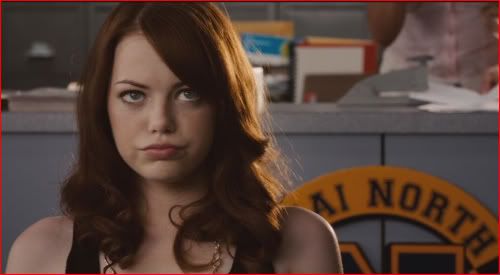
"It is a well-known claim of actors, oft attributed to the British stage star Edmund Kean but probably originated by some schlub pounding the dirt in a Greek amphitheater around the time Lysistrata had its premiere: dying is easy, but comedy is hard. As much as this deathbed classic is a Hollywood truism, there is apparently something even more difficult than peerlessly nailing a comedy role and that's getting any recognition for having done so. Of the 10 lead performance nominees at this year’s Academy Awards, seven of them bent over backward to keep their audiences from cracking a smile. (The eventual Best Actress winner delivered laugh after unintended laugh in her very serious turn as a bat-shit ballerina.) Even my own list of favorite performances, male or female, is heavily weighted toward searing dramatic turns. Yet year after year the performances that land at the top of my list are usually comedic in nature. (I’m thinking of Anna Faris in The House Bunny, Steve Martin in The Man with Two Brains and Jeff Bridges in The Big Lebowski, to name but just three.) With all due respect to Michele Williams, Annette Bening, Lesley Manville and Hailee Steinfeld, only one actress this year was able to convince me, if she were to somehow hijack Doc Brown’s DeLorean and travel back to the golden age of Hollywood screwball comedy, that she could be dropped, as is, straight into competition with the high-speed royalty of the genre for all the best and brightest roles. And I’ve little doubt not only that Emma Stone could hold her own, but that she would have the likes of Carole Lombard, Marion Davies, Katharine Hepburn, Irene Dunne and Jean Arthur looking over their shoulders when they weren’t scrambling to take her out for drinks.
In Easy A Stone effortlessly proved she had the stuff real stars are made of. In the real world, or at least in my high school, Stone's Olive Penderghast would have had every boy with a lick of sense at her feet. But here she’s nerdy and boyfriend-less (the movie’s most outrageous conceit), North Ojai High's heiress apparent to the spirit, if not the legacy or fate of Hester Prynne. Olive finds herself the object of salacious rumors, in part self-perpetuated, which result in her becoming the go-to girl for unconsummated, wholly fictitious trysts meant to prop up the reputations of her supposed partners, desperate geeks one and all. Of course the rumors go wildly out of control and Olive, in best-defense mode, embraces her nouveau-slutty persona, with results that are predictably outrageous but less predictably hilarious, and even at times painful. This young actress holds the screen without ever breaking a sweat—she’s in practically every scene of her movie, just like Oscar-winner Natalie Portman. The difference is that there’s no doubt Stone means to make us laugh.
In addition to effortless and natural appeal, Stone has got a real movie smart-ass’s way around a sharply written turn of phrase, or a squinty-smudgy smirk-mock laugh, displayed without turning the screen a red-headed shade of mean a la Molly Ringwald. (Maybe it’s her slight lisp that keeps her barbs from cutting too deep or seeming elitist.) But she can also handle the sweetness in the teen comedy recipe without feeling the need to put everything in collagen-inflated quotes or brush off the currents of love coursing through her relationship with her only-in-the-movies family in appeasement of the movie’s mockery-ready ideal demographic. Even her looks are appealingly off-kilter; her freckled nose crinkles up to meet those pale green eyes, which are spaced slightly further apart than the manual recommends and offset by her fiery red mane; and all of her features settle into a repertoire of quizzical looks, sharp glances and artfully arched eyebrows that suggest bemusement and the pursuit of the cleansing power of humor as the most potent intellectual defense against shallow high school hostility.
One thing Stone is not is a flavor-of-the-moment cutie pie. No, she’s a tart meringue, and on the strength of Easy A she’s fully ready to take on all comers for now and the foreseeable future. Like Faris, with whom she shared screen time in The House Bunny, Stone is built for the kinds of showcase vehicles that Hollywood forgot how to make 50 years ago. (With all due respect to the late, great Jane Russell, if someone ever decides to do a remake of Gentlemen Prefer Blondes there would be no need to go through all that messy auditioning and interviewing-- just give these women the ship and watch ‘em cruise.) It may be that Stone never gets another role like Olive-- her ascendance into the rebooted Spider-Man franchise bodes well for her profile, Q rating and checking account, but it’s unlikely to produce the sort of combustible energy she radiates in Easy A. As she becomes a star, I’ll eagerly await the career fulfillment of the kind of intelligence she’s displayed in her choices so far and continue to hope she remembers that anyone can take the money; it’s comedy that’s hard, and nothing worth doing comes easy. The glint in Emma Stone’s green eyes tells me that she’s ready to roll up her sleeves and get to work." - Dennis Cozzalio

"At first glance, the title of Mike Leigh’s Another Year obviously refers to the growing season of the garden tended by Tom and Gerri (Jim Broadbent and Ruth Sheen) through the course of the movie – a metaphor for hope, life, and the joys of growing old as part of a loving couple. As the film develops, however, Tom and Gerri are slowly replaced as the film’s focus by their friend Mary (Lesley Manville), an unhappy woman heading into middle age with a dead-end job, a futile love life, and a drinking problem. As we pay attention to Mary’s not-very-quiet desperation, the film’s title reveals a painful irony – while Tom and Gerri’s year is full of rewarding careers and dinners with friends and loved ones, Mary’s year careens from one disappointment to the next, with no end in sight.
One of the most difficult things for any actor to do is to play a character defined by weakness, passivity, and confusion without lapsing into stereotypes – the suffering saint, the hapless fool, the they-had-it-coming loser. What Manville succeeds in doing is to create a character of failure and pain without falling prey to condescension or alienation. Mary could be any one of us, and her misery is noone’s fault. She’s just another of the lonely people, not understanding what she’s doing wrong, not knowing where to go from here. And the degree of empathy and connection that Manville and Leigh provide between Mary and the audience is one of the purest, most beautiful things to discover in all of art – our simple recognition of a tortured soul." - Jeff McMahon

"Teenagers aren’t supposed to have their shit together. It’s a fact of life. As Ron Burgundy would say, it’s science.
However, if you’re a teenager growing up in the Ozarks, in a community where the inhabitants don’t seem to know the meaning of the word, taking care of your little brother and sister while your mother sits catatonic in the living room, looking for your possibly dead, meth-cooking father so you and your family won’t end up homeless, not to mention risking life and limb (both literally) just trying to locate the deadbeat son of a bitch, I guess getting your shit together would be something of a requirement.
As Ree, the 17-year-old who is forced to deal with all those aforementioned things, Jennifer Lawrence’s performance in Winter’s Bone consists of her character showing how growing up in these harshest of conditions has made her not just tough and mature, but a force to be reckoned with. She doesn’t back down as fearful relatives and neighbors tell her to quit with all the snooping around. And even when she gets brutally attacked and apprehended by the people responsible for her old man’s disappearance, her chances of making it out alive close to nil, she doesn’t become a sobbing, sniveling mess begging for her life. Her upper lip stays surprisingly stiff, telling her captors they can either kill her or help her. She actually tells them what they should do. Even when she’s bruised and bloodied, she remains the strongest person in the room. (It’s funny how magazines and other media outlets are out to show how smokin’ hot Lawrence looks in swimwear, considering she gives one of the most unglamorous performances in recent memory.)
It’s quite an impressive, resilient turn from Lawrence, who was previously known for being the resident jailbait daughter on "The Bill Engvall Show." Just as Ree is out to quietly, valiantly show she’s up to any challenge, so does Lawrence. It’s a performance that’s practically the flip side of Natalie Portman’s Oscar-winning turn in Black Swan. As Portman’s uptight, pampered ballerina drives herself batty in her quest to become the perfect lead in Swan Lake, eventually pirouetting to her own fatal demise, Lawrence’s ballsy, dirt-poor teen virtually goes through hell on earth, keeping not just a cool, brave head throughout but coming out of it sane and in one piece. Portman was really good in her performance, but Lawrence just kept it real in hers." – Craig D. Lindsey

"As good as Natalie Portman was in Black Swan, it stung to see Annette Bening passed over again in favor of a young ingénue, having previous lost - twice - to Hilary Swank. Granted, the previous two times I felt the winning performances were better and more deserving (in particular, Swank’s lacerating performance in Boys Don’t Cry easily bested Bening’s chilly housewife in American Beauty), but this time, for her rather remarkable work in The Kids Are All Right, she really deserved it.
Lisa Cholodenko’s excellent film, through its incisive yet non-showy script and lived-in performances, captured the unspoken subtleties of long-term relationships and family life, and no one in the cast excelled in their job more than Bening. As Nic, the more masculine, pants-wearing half of a committed lesbian relationship with Julianne Moore’s flighty Jules, she commanded the screen with her every scene, every line reading, every gesture. She wasn’t Hollywood Actress Annette Bening, she was Nic, and she did it without showing off. In her greatest scene (at Ruffalo’s dinner table having just pieced together the truth about Jules’s infidelity, as she silently smiles while imploding on the inside), she barely moves and doesn’t speak. She acts with her posture and especially her eyes, which shine in concert with her fake smile but more importantly reveal the simultaneous hurt, rage and disappointment tearing her apart on the inside, and it is riveting.
Her character, smart and no-nonsense to a fault but caring and fiercely protective of her family, isn’t always easy to like but is always a full-blooded, understandable human being. And one who is never at a loss to remind you that she needs your advice like she needs “a dick in [her] ass.” Well-put!" - Jason Alley
"It is a well-known claim of actors, oft attributed to the British stage star Edmund Kean but probably originated by some schlub pounding the dirt in a Greek amphitheater around the time Lysistrata had its premiere: dying is easy, but comedy is hard. As much as this deathbed classic is a Hollywood truism, there is apparently something even more difficult than peerlessly nailing a comedy role and that's getting any recognition for having done so. Of the 10 lead performance nominees at this year’s Academy Awards, seven of them bent over backward to keep their audiences from cracking a smile. (The eventual Best Actress winner delivered laugh after unintended laugh in her very serious turn as a bat-shit ballerina.) Even my own list of favorite performances, male or female, is heavily weighted toward searing dramatic turns. Yet year after year the performances that land at the top of my list are usually comedic in nature. (I’m thinking of Anna Faris in The House Bunny, Steve Martin in The Man with Two Brains and Jeff Bridges in The Big Lebowski, to name but just three.) With all due respect to Michele Williams, Annette Bening, Lesley Manville and Hailee Steinfeld, only one actress this year was able to convince me, if she were to somehow hijack Doc Brown’s DeLorean and travel back to the golden age of Hollywood screwball comedy, that she could be dropped, as is, straight into competition with the high-speed royalty of the genre for all the best and brightest roles. And I’ve little doubt not only that Emma Stone could hold her own, but that she would have the likes of Carole Lombard, Marion Davies, Katharine Hepburn, Irene Dunne and Jean Arthur looking over their shoulders when they weren’t scrambling to take her out for drinks.
In Easy A Stone effortlessly proved she had the stuff real stars are made of. In the real world, or at least in my high school, Stone's Olive Penderghast would have had every boy with a lick of sense at her feet. But here she’s nerdy and boyfriend-less (the movie’s most outrageous conceit), North Ojai High's heiress apparent to the spirit, if not the legacy or fate of Hester Prynne. Olive finds herself the object of salacious rumors, in part self-perpetuated, which result in her becoming the go-to girl for unconsummated, wholly fictitious trysts meant to prop up the reputations of her supposed partners, desperate geeks one and all. Of course the rumors go wildly out of control and Olive, in best-defense mode, embraces her nouveau-slutty persona, with results that are predictably outrageous but less predictably hilarious, and even at times painful. This young actress holds the screen without ever breaking a sweat—she’s in practically every scene of her movie, just like Oscar-winner Natalie Portman. The difference is that there’s no doubt Stone means to make us laugh.
In addition to effortless and natural appeal, Stone has got a real movie smart-ass’s way around a sharply written turn of phrase, or a squinty-smudgy smirk-mock laugh, displayed without turning the screen a red-headed shade of mean a la Molly Ringwald. (Maybe it’s her slight lisp that keeps her barbs from cutting too deep or seeming elitist.) But she can also handle the sweetness in the teen comedy recipe without feeling the need to put everything in collagen-inflated quotes or brush off the currents of love coursing through her relationship with her only-in-the-movies family in appeasement of the movie’s mockery-ready ideal demographic. Even her looks are appealingly off-kilter; her freckled nose crinkles up to meet those pale green eyes, which are spaced slightly further apart than the manual recommends and offset by her fiery red mane; and all of her features settle into a repertoire of quizzical looks, sharp glances and artfully arched eyebrows that suggest bemusement and the pursuit of the cleansing power of humor as the most potent intellectual defense against shallow high school hostility.
One thing Stone is not is a flavor-of-the-moment cutie pie. No, she’s a tart meringue, and on the strength of Easy A she’s fully ready to take on all comers for now and the foreseeable future. Like Faris, with whom she shared screen time in The House Bunny, Stone is built for the kinds of showcase vehicles that Hollywood forgot how to make 50 years ago. (With all due respect to the late, great Jane Russell, if someone ever decides to do a remake of Gentlemen Prefer Blondes there would be no need to go through all that messy auditioning and interviewing-- just give these women the ship and watch ‘em cruise.) It may be that Stone never gets another role like Olive-- her ascendance into the rebooted Spider-Man franchise bodes well for her profile, Q rating and checking account, but it’s unlikely to produce the sort of combustible energy she radiates in Easy A. As she becomes a star, I’ll eagerly await the career fulfillment of the kind of intelligence she’s displayed in her choices so far and continue to hope she remembers that anyone can take the money; it’s comedy that’s hard, and nothing worth doing comes easy. The glint in Emma Stone’s green eyes tells me that she’s ready to roll up her sleeves and get to work." - Dennis Cozzalio
"At first glance, the title of Mike Leigh’s Another Year obviously refers to the growing season of the garden tended by Tom and Gerri (Jim Broadbent and Ruth Sheen) through the course of the movie – a metaphor for hope, life, and the joys of growing old as part of a loving couple. As the film develops, however, Tom and Gerri are slowly replaced as the film’s focus by their friend Mary (Lesley Manville), an unhappy woman heading into middle age with a dead-end job, a futile love life, and a drinking problem. As we pay attention to Mary’s not-very-quiet desperation, the film’s title reveals a painful irony – while Tom and Gerri’s year is full of rewarding careers and dinners with friends and loved ones, Mary’s year careens from one disappointment to the next, with no end in sight.
One of the most difficult things for any actor to do is to play a character defined by weakness, passivity, and confusion without lapsing into stereotypes – the suffering saint, the hapless fool, the they-had-it-coming loser. What Manville succeeds in doing is to create a character of failure and pain without falling prey to condescension or alienation. Mary could be any one of us, and her misery is noone’s fault. She’s just another of the lonely people, not understanding what she’s doing wrong, not knowing where to go from here. And the degree of empathy and connection that Manville and Leigh provide between Mary and the audience is one of the purest, most beautiful things to discover in all of art – our simple recognition of a tortured soul." - Jeff McMahon
"Teenagers aren’t supposed to have their shit together. It’s a fact of life. As Ron Burgundy would say, it’s science.
However, if you’re a teenager growing up in the Ozarks, in a community where the inhabitants don’t seem to know the meaning of the word, taking care of your little brother and sister while your mother sits catatonic in the living room, looking for your possibly dead, meth-cooking father so you and your family won’t end up homeless, not to mention risking life and limb (both literally) just trying to locate the deadbeat son of a bitch, I guess getting your shit together would be something of a requirement.
As Ree, the 17-year-old who is forced to deal with all those aforementioned things, Jennifer Lawrence’s performance in Winter’s Bone consists of her character showing how growing up in these harshest of conditions has made her not just tough and mature, but a force to be reckoned with. She doesn’t back down as fearful relatives and neighbors tell her to quit with all the snooping around. And even when she gets brutally attacked and apprehended by the people responsible for her old man’s disappearance, her chances of making it out alive close to nil, she doesn’t become a sobbing, sniveling mess begging for her life. Her upper lip stays surprisingly stiff, telling her captors they can either kill her or help her. She actually tells them what they should do. Even when she’s bruised and bloodied, she remains the strongest person in the room. (It’s funny how magazines and other media outlets are out to show how smokin’ hot Lawrence looks in swimwear, considering she gives one of the most unglamorous performances in recent memory.)
It’s quite an impressive, resilient turn from Lawrence, who was previously known for being the resident jailbait daughter on "The Bill Engvall Show." Just as Ree is out to quietly, valiantly show she’s up to any challenge, so does Lawrence. It’s a performance that’s practically the flip side of Natalie Portman’s Oscar-winning turn in Black Swan. As Portman’s uptight, pampered ballerina drives herself batty in her quest to become the perfect lead in Swan Lake, eventually pirouetting to her own fatal demise, Lawrence’s ballsy, dirt-poor teen virtually goes through hell on earth, keeping not just a cool, brave head throughout but coming out of it sane and in one piece. Portman was really good in her performance, but Lawrence just kept it real in hers." – Craig D. Lindsey
"As good as Natalie Portman was in Black Swan, it stung to see Annette Bening passed over again in favor of a young ingénue, having previous lost - twice - to Hilary Swank. Granted, the previous two times I felt the winning performances were better and more deserving (in particular, Swank’s lacerating performance in Boys Don’t Cry easily bested Bening’s chilly housewife in American Beauty), but this time, for her rather remarkable work in The Kids Are All Right, she really deserved it.
Lisa Cholodenko’s excellent film, through its incisive yet non-showy script and lived-in performances, captured the unspoken subtleties of long-term relationships and family life, and no one in the cast excelled in their job more than Bening. As Nic, the more masculine, pants-wearing half of a committed lesbian relationship with Julianne Moore’s flighty Jules, she commanded the screen with her every scene, every line reading, every gesture. She wasn’t Hollywood Actress Annette Bening, she was Nic, and she did it without showing off. In her greatest scene (at Ruffalo’s dinner table having just pieced together the truth about Jules’s infidelity, as she silently smiles while imploding on the inside), she barely moves and doesn’t speak. She acts with her posture and especially her eyes, which shine in concert with her fake smile but more importantly reveal the simultaneous hurt, rage and disappointment tearing her apart on the inside, and it is riveting.
Her character, smart and no-nonsense to a fault but caring and fiercely protective of her family, isn’t always easy to like but is always a full-blooded, understandable human being. And one who is never at a loss to remind you that she needs your advice like she needs “a dick in [her] ass.” Well-put!" - Jason Alley
Friday, March 4, 2011
Muriel Award: Best Actor
This race ended up being a lot closer than I expected. A surprise to me - I did not see the support for the second-place finisher being as strong as it was. This is why I don't do prognostication.
Third place:

Tahar Rahim, A Prophet [90 points / 14 votes]
Second place:

Edgar Ramirez, Carlos [135/20]
And your winner...
Third place:
Tahar Rahim, A Prophet [90 points / 14 votes]
Second place:
Edgar Ramirez, Carlos [135/20]
And your winner...
Other Stuff We Liked, Part 1: Actors
Every year, as this whole shebang winds down, we like to spotlight some aspects of the past year's cinema that, while not a consensus favorite, still resonated with a fair portion of the voting body. So let's do that again!

"While Colin Firth's performance as Henry VI in The King's Speech struck me as incredibly affecting, James Franco's tour de force as misguided hiking adventurer Aron Ralston in 127 Hours absolutely floored me. It was the first time the actor struck me as a method actor who could some day be counted in the same class as Marlon Brando, Robert De Niro, and - hey, go with me on this - Steve Buscemi.
A tough, desperate piece of acting gold shines through every action of Franco's character. That it's based on a real guy's severe dilemma makes perfect stressful sense for the odd meta actor whose career is full of conundrums. Franco went to the dark side in his wrenching yet always relatable portrayal of human suffering and perseverance. That he had us so with him as he came out from that darkness into the most life-affirming shot of blinding light I've ever seen at the movies cements his ownage of the part for sure." - Daniel Johnson

"Ryan Gosling’s short but stunning roller coaster of a career has seen epic highs (The Believer, Half Nelson) and forgettable lows (Fracture), but his range and dedication remain unquestioned. He’s a true method actor, a meticulous throwback to the glory days of Pacino and DeNiro where every quiver, twitch, and wrinkle connects with the interior subtext of the character. He has played a skilled serial killer and a drugged-out teacher, a conflicted neo-nazi and a man enamored with a sex doll. But maybe not so ironically, Gosling is best known for playing a tortured romantic in The Notebook, a film that despite its charms isn’t especially challenging for his caliber of actor. All in all, mainstream success has eluded Gosling, and he’s flown somewhat under the radar except for those deeply entrenched in the film industry.
Yet 2010 seems to have changed everything for Gosling. His brilliantly nuanced performance as Dean in Derek Cianfrance’s devastating Blue Valentine feels like a watershed moment, a graduation of sorts to legendary status. The film’s flashback structure is wholly dependent on the contrasting tones of Gosling and his co-star Michelle Williams’ performances, and both are able to construct an entire universe of subtext out of small moments. As a man slowly being torn apart by hidden disappointment, Gosling’s Dean, balding but still piercing, is enthralling for his ability to circumvent cliche, building on the natural chemistry with Williams until every silent glance and subtle shrug entails something deeper -- an endless amount of variations within a constantly fluid relationship.
When Cianfrance cuts backward in time, Gosling brings a eager yearning to Dean as a younger man, full of vim and vigor but still aware of the harsh realities of everyday life. While Dean and Cindy meet by chance, every ounce of their relationship, both the good, the bad, and the ugly, feels dynamic, real, and fated, a momentary window into a relationship that can’t hit the reset button. The film’s overall power (gleaned from plenty of individual stunning moments) is a testament to the careful precision of Gosling’s movement and pitch. The sequence in the Future Room is especially devastating on a personal level, a greatest (or worst) hits collection of compromise, hope, dedication, and finally disintegration. Compare this heartbreaking valley with the glorious high of Dean serenading Cindy on a sidewalk stoop, “singing stupid” for a woman he can’t keep his eyes off, and the magnitude of Gosling’s performance becomes clear. Blue Valentine ends with Dean walking down the street away from Cindy, his daughter, and the life he wants so badly to sustain. As the fireworks of July 4th celebrations rip through the space, we are left with an iconic image of an actor taking it to the next level, and a fascinating and tormented character who can’t bare to look back. It's just too painful." - Glenn Heath Jr.

"Forget for a minute the success or failure of the "is it real or is it a stunt?" controversy at the core of Joaquin Phoenix's faux documentary I'm Still Here. Forget too the pouty dismissal the film mostly received by a lazy critical and entertainment journalism establishment that didn't take kindly to being one of the objects of the joke. Focus instead on Phoenix's risky, envelope-pushing, career-threatening yet wholly convincing performance as ostensibly himself, a promising young actor turned bloated, self-absorbed celebrity prepared to throw everything away for a vanity career as a rap act.
Consider too that this wasn't just a performance in the context of a 90-minute film. It was a nearly year-long bit of ballsy performance art in which Phoenix basically put his acting/celebrity career on hold to make a massive public ass of himself everywhere from a stage in Miami to the bright lights of The Late Show with David Letterman. Almost universally overlooked and misunderstood, it was not only the performance of 2010, it was possibly the performance of an actor's lifetime.
Even if you strip away the meat of the excoriating celebrity culture satire that is I'm Still Here (and why would you unless it hits too close to home?), you're left with a pretty brilliant comic performance worthy of This Is Spinal Tap or Waiting for Guffman. What's more, the comedy comes at the expense of Phoenix the actor who, even when you know it's a put on, isn't allowed the cover of an obviously invented comic character. What more can you ask from a guy?
But I'm Still Here isn't just a lark. There's a sting to it and it's due entirely to Phoenix who seizes the humanity in his character early on in the film. The resulting performance is shot through with a pathos that grounds it and keeps it from being an act of simple buffoonery. There's a genuine feeling of truth to the opening scene where an exhausted and depressed looking Phoenix laments his weariness at playing "Joaquin Phoenix." It's tempting to believe that, however much of this screen persona may be invented, this emptiness at least is shared by the real man.
Joaquin Phoenix, your masterpiece may have been greeted with a shrug by critics and audiences who have now moved on to the daily antics of Charlie Sheen, but you, sir, are a mountaintop water drop." - Craig Kennedy

"You’d be easily forgiven if you didn’t make an immediate connection between Niels Arestrup the grizzled veteran and the fresh-faced pretty boy featured in Chantal Akerman’s 1974 classic I, You, He, She or the many other French films where Arestrup used his youthful good looks to his advantage. Jacques Audiard has twice now employed the weathered face and cold eyes of Arestrup’s present appearance to personify heartless, dangerous men with zero moral standing. In The Beat My Heart Skipped, he played a drunken, cowardly, deadbeat nightmare of a father who convinces his son (Romain Duris) to help him collect on his debts and gets him mixed up in an underworld that doesn’t give friendly introductions. In A Prophet, Arestrup reappears as Cesar Luciani, the ruthless Corsican prison boss that takes the film’s lead Malik on as his young protégé. Both roles earned the veteran actor a Cesar, the equivalent of an Academy Award in his home country.
Simply put, Cesar Luciani is a man you don’t question, you don’t talk back to and you certainly don’t fuck with. When he tells Malik that he must kill a man in his cellblock or he will kill Malik, there isn’t a single moment of doubt that his fate has been decided. Cesar is a man of confidence, a prison lifer who still has ties to the outside world and acts as if his imprisonment is just an irritating handicap to conducting business. He carries himself with a masculine swagger that clears lanes as he walks the prison’s halls despite his Napoleon-like stature. He is a cruel man that has learned to do anything necessary to get results. The film’s brutal portrayal of life inside this cement box is so visceral that it can be difficult to watch. There were scenes, at least one involving Cesar, that I had to briefly look away from. But it is precisely these kinds of scenes that buy Audiard so much credibility with viewers, especially when his actors so fully inhabit their characters that you would have no trouble believing they’d spent a good portion of their lives locked within the confines of this prison.
As the film tracks Malik’s unlikely rise and Cesar’s inevitable fall there is always a palpable sense of danger. Cesar’s menacing looks never let you relax and there's the omnipresent fear that Malik may make that one crucial mistake that pushes him into a violent conclusion; there is, then, a moment of slight satisfaction when an utterly defeated Cesar sitts in the grey square, surrounded by snow and ice, completely alone. There are no words necessary, Arestrup’s face tells you everything you need to know about a man being forced to face the consuming emptiness that will haunt the remainder of his life. Niels Arestrup has grown into that rare breed of actor who is so compelling you would pay good money just to watch him sit and smoke a cigarette or read a book. I know I would." - Bryan Whitefield

"It’s difficult to capture exactly what’s so special about up-and-comer Michael Fassbender and indie vet Mark Ruffalo in Fish Tank and The Kids Are All Right, respectively. Both performances, each a supporting turn, act as a narrative and sexual catalyst, pushing their movies (and central female leads) into moral and interpersonal disillusion. Both performances also exist in similarly flawed films, each hampered by schematic screenplays. Yet it’s the former who remains mostly unscathed, managing to elude simplistic arcs and easy answers in favor of a certain level of intrigue and mystery.In Fish Tank, Fassbender plays one of Mom’s (Kierston Wareing) new lovers, and who comes to have a complex relationship with Mia, (Katie Jarvis) our lead. There’s a subtle, appealing body language to Fassbender’s performance, oozing sexuality and confidence, but gentle in motion and speech. The turn is perhaps so elusive as to eschew description in itself, but it’s with no doubt a beseeching, agreeable turn suffused with empathy and cozy compassion, always surprising and a appropriately warm welcome for this commanding presence." - Charles Lyons
"While Colin Firth's performance as Henry VI in The King's Speech struck me as incredibly affecting, James Franco's tour de force as misguided hiking adventurer Aron Ralston in 127 Hours absolutely floored me. It was the first time the actor struck me as a method actor who could some day be counted in the same class as Marlon Brando, Robert De Niro, and - hey, go with me on this - Steve Buscemi.
A tough, desperate piece of acting gold shines through every action of Franco's character. That it's based on a real guy's severe dilemma makes perfect stressful sense for the odd meta actor whose career is full of conundrums. Franco went to the dark side in his wrenching yet always relatable portrayal of human suffering and perseverance. That he had us so with him as he came out from that darkness into the most life-affirming shot of blinding light I've ever seen at the movies cements his ownage of the part for sure." - Daniel Johnson
"Ryan Gosling’s short but stunning roller coaster of a career has seen epic highs (The Believer, Half Nelson) and forgettable lows (Fracture), but his range and dedication remain unquestioned. He’s a true method actor, a meticulous throwback to the glory days of Pacino and DeNiro where every quiver, twitch, and wrinkle connects with the interior subtext of the character. He has played a skilled serial killer and a drugged-out teacher, a conflicted neo-nazi and a man enamored with a sex doll. But maybe not so ironically, Gosling is best known for playing a tortured romantic in The Notebook, a film that despite its charms isn’t especially challenging for his caliber of actor. All in all, mainstream success has eluded Gosling, and he’s flown somewhat under the radar except for those deeply entrenched in the film industry.
Yet 2010 seems to have changed everything for Gosling. His brilliantly nuanced performance as Dean in Derek Cianfrance’s devastating Blue Valentine feels like a watershed moment, a graduation of sorts to legendary status. The film’s flashback structure is wholly dependent on the contrasting tones of Gosling and his co-star Michelle Williams’ performances, and both are able to construct an entire universe of subtext out of small moments. As a man slowly being torn apart by hidden disappointment, Gosling’s Dean, balding but still piercing, is enthralling for his ability to circumvent cliche, building on the natural chemistry with Williams until every silent glance and subtle shrug entails something deeper -- an endless amount of variations within a constantly fluid relationship.
When Cianfrance cuts backward in time, Gosling brings a eager yearning to Dean as a younger man, full of vim and vigor but still aware of the harsh realities of everyday life. While Dean and Cindy meet by chance, every ounce of their relationship, both the good, the bad, and the ugly, feels dynamic, real, and fated, a momentary window into a relationship that can’t hit the reset button. The film’s overall power (gleaned from plenty of individual stunning moments) is a testament to the careful precision of Gosling’s movement and pitch. The sequence in the Future Room is especially devastating on a personal level, a greatest (or worst) hits collection of compromise, hope, dedication, and finally disintegration. Compare this heartbreaking valley with the glorious high of Dean serenading Cindy on a sidewalk stoop, “singing stupid” for a woman he can’t keep his eyes off, and the magnitude of Gosling’s performance becomes clear. Blue Valentine ends with Dean walking down the street away from Cindy, his daughter, and the life he wants so badly to sustain. As the fireworks of July 4th celebrations rip through the space, we are left with an iconic image of an actor taking it to the next level, and a fascinating and tormented character who can’t bare to look back. It's just too painful." - Glenn Heath Jr.
"Forget for a minute the success or failure of the "is it real or is it a stunt?" controversy at the core of Joaquin Phoenix's faux documentary I'm Still Here. Forget too the pouty dismissal the film mostly received by a lazy critical and entertainment journalism establishment that didn't take kindly to being one of the objects of the joke. Focus instead on Phoenix's risky, envelope-pushing, career-threatening yet wholly convincing performance as ostensibly himself, a promising young actor turned bloated, self-absorbed celebrity prepared to throw everything away for a vanity career as a rap act.
Consider too that this wasn't just a performance in the context of a 90-minute film. It was a nearly year-long bit of ballsy performance art in which Phoenix basically put his acting/celebrity career on hold to make a massive public ass of himself everywhere from a stage in Miami to the bright lights of The Late Show with David Letterman. Almost universally overlooked and misunderstood, it was not only the performance of 2010, it was possibly the performance of an actor's lifetime.
Even if you strip away the meat of the excoriating celebrity culture satire that is I'm Still Here (and why would you unless it hits too close to home?), you're left with a pretty brilliant comic performance worthy of This Is Spinal Tap or Waiting for Guffman. What's more, the comedy comes at the expense of Phoenix the actor who, even when you know it's a put on, isn't allowed the cover of an obviously invented comic character. What more can you ask from a guy?
But I'm Still Here isn't just a lark. There's a sting to it and it's due entirely to Phoenix who seizes the humanity in his character early on in the film. The resulting performance is shot through with a pathos that grounds it and keeps it from being an act of simple buffoonery. There's a genuine feeling of truth to the opening scene where an exhausted and depressed looking Phoenix laments his weariness at playing "Joaquin Phoenix." It's tempting to believe that, however much of this screen persona may be invented, this emptiness at least is shared by the real man.
Joaquin Phoenix, your masterpiece may have been greeted with a shrug by critics and audiences who have now moved on to the daily antics of Charlie Sheen, but you, sir, are a mountaintop water drop." - Craig Kennedy
"You’d be easily forgiven if you didn’t make an immediate connection between Niels Arestrup the grizzled veteran and the fresh-faced pretty boy featured in Chantal Akerman’s 1974 classic I, You, He, She or the many other French films where Arestrup used his youthful good looks to his advantage. Jacques Audiard has twice now employed the weathered face and cold eyes of Arestrup’s present appearance to personify heartless, dangerous men with zero moral standing. In The Beat My Heart Skipped, he played a drunken, cowardly, deadbeat nightmare of a father who convinces his son (Romain Duris) to help him collect on his debts and gets him mixed up in an underworld that doesn’t give friendly introductions. In A Prophet, Arestrup reappears as Cesar Luciani, the ruthless Corsican prison boss that takes the film’s lead Malik on as his young protégé. Both roles earned the veteran actor a Cesar, the equivalent of an Academy Award in his home country.
Simply put, Cesar Luciani is a man you don’t question, you don’t talk back to and you certainly don’t fuck with. When he tells Malik that he must kill a man in his cellblock or he will kill Malik, there isn’t a single moment of doubt that his fate has been decided. Cesar is a man of confidence, a prison lifer who still has ties to the outside world and acts as if his imprisonment is just an irritating handicap to conducting business. He carries himself with a masculine swagger that clears lanes as he walks the prison’s halls despite his Napoleon-like stature. He is a cruel man that has learned to do anything necessary to get results. The film’s brutal portrayal of life inside this cement box is so visceral that it can be difficult to watch. There were scenes, at least one involving Cesar, that I had to briefly look away from. But it is precisely these kinds of scenes that buy Audiard so much credibility with viewers, especially when his actors so fully inhabit their characters that you would have no trouble believing they’d spent a good portion of their lives locked within the confines of this prison.
As the film tracks Malik’s unlikely rise and Cesar’s inevitable fall there is always a palpable sense of danger. Cesar’s menacing looks never let you relax and there's the omnipresent fear that Malik may make that one crucial mistake that pushes him into a violent conclusion; there is, then, a moment of slight satisfaction when an utterly defeated Cesar sitts in the grey square, surrounded by snow and ice, completely alone. There are no words necessary, Arestrup’s face tells you everything you need to know about a man being forced to face the consuming emptiness that will haunt the remainder of his life. Niels Arestrup has grown into that rare breed of actor who is so compelling you would pay good money just to watch him sit and smoke a cigarette or read a book. I know I would." - Bryan Whitefield
"It’s difficult to capture exactly what’s so special about up-and-comer Michael Fassbender and indie vet Mark Ruffalo in Fish Tank and The Kids Are All Right, respectively. Both performances, each a supporting turn, act as a narrative and sexual catalyst, pushing their movies (and central female leads) into moral and interpersonal disillusion. Both performances also exist in similarly flawed films, each hampered by schematic screenplays. Yet it’s the former who remains mostly unscathed, managing to elude simplistic arcs and easy answers in favor of a certain level of intrigue and mystery.In Fish Tank, Fassbender plays one of Mom’s (Kierston Wareing) new lovers, and who comes to have a complex relationship with Mia, (Katie Jarvis) our lead. There’s a subtle, appealing body language to Fassbender’s performance, oozing sexuality and confidence, but gentle in motion and speech. The turn is perhaps so elusive as to eschew description in itself, but it’s with no doubt a beseeching, agreeable turn suffused with empathy and cozy compassion, always surprising and a appropriately warm welcome for this commanding presence." - Charles Lyons
Thursday, March 3, 2011
Muriel Award: Best Director
Third place:

Joel & Ethan Coen, True Grit [58 points / 9 ballots]
Second place:

Olivier Assayas, Carlos [67/11]
And your winner...
Joel & Ethan Coen, True Grit [58 points / 9 ballots]
Second place:
Olivier Assayas, Carlos [67/11]
And your winner...
Wednesday, March 2, 2011
Muriel Award: Best Cinematic Moment
And now we get to my favorite category, in no small measure because of the wide and varied reactions it represents. This, for me, is the part of the ballot where each of our personal tastes and idiosyncrasies get to shine and stretch in the light.
That said, like the Godzilla fight in Crank II, I find myself agog that I'm left out in the cold on one particular scene. Actually, I think I went solo on about half my picks... but come on. Only one other voter tipped their cap to this insanity? If you've seen the film, you know what's happening: CAT MUNCHIES.
That said, here's a selection of the scenes that, while not winners, did receive a significant amount of love:
(Once again, I tip my cap to Mike D'Angelo for a few of these videos and hope he doesn't mind me jackin' 'em.)
Piranha 3D - Underwater ballet (couldn't find that scene, sadly, so here's the body shot scene, which achieves the same kind of prurient interest much quicker - though, also, with less nudity)
127 Hours - Talk show
Scott Pilgrim vs. the World - Sex Bob-Omb vs. the Katayanagi twins
Sweetgrass - That sheep!
The Ghost Writer - The bitter end (click through to watch it)
Enter the Void - Opening credits
Dogtooth - anniversary dance
What could have topped these awesome slices of cinema, you say? Let's look and see!
Third place:
Black Swan - Nina Sayers IS the Black Swan [109 points / 11 votes]
Second place:
sk5
Uploaded by gemko. - Watch feature films and entire TV shows.
Let Me In - "Burning for You" [127/13]
And your winner...
That said, like the Godzilla fight in Crank II, I find myself agog that I'm left out in the cold on one particular scene. Actually, I think I went solo on about half my picks... but come on. Only one other voter tipped their cap to this insanity? If you've seen the film, you know what's happening: CAT MUNCHIES.
That said, here's a selection of the scenes that, while not winners, did receive a significant amount of love:
(Once again, I tip my cap to Mike D'Angelo for a few of these videos and hope he doesn't mind me jackin' 'em.)
Piranha 3D - Underwater ballet (couldn't find that scene, sadly, so here's the body shot scene, which achieves the same kind of prurient interest much quicker - though, also, with less nudity)
Untitled from Daniel Gemko on Vimeo.
127 Hours - Talk show
Scott Pilgrim vs. the World - Sex Bob-Omb vs. the Katayanagi twins
Sweetgrass - That sheep!
The Ghost Writer - The bitter end (click through to watch it)
Enter the Void - Opening credits
Dogtooth - anniversary dance
What could have topped these awesome slices of cinema, you say? Let's look and see!
Third place:
Black Swan - Nina Sayers IS the Black Swan [109 points / 11 votes]
Second place:
sk5
Uploaded by gemko. - Watch feature films and entire TV shows.
Let Me In - "Burning for You" [127/13]
And your winner...
Tuesday, March 1, 2011
Muriel Award: Best Screenplay
Third place:

Dogtooth (written by Yorgos Lanthimos and Efthymis Filippou) [70 points / 10 votes]
Second place:

True Grit (written by Joel & Ethan Coen, based on the novel by Charles Portis) [101/18]
And your winner...
Dogtooth (written by Yorgos Lanthimos and Efthymis Filippou) [70 points / 10 votes]
Second place:
True Grit (written by Joel & Ethan Coen, based on the novel by Charles Portis) [101/18]
And your winner...
Subscribe to:
Posts (Atom)